





Case Studies
How StableClerk Uses ZeroDev Wallet for Self-Custodied USDC Payments
August 27, 2026
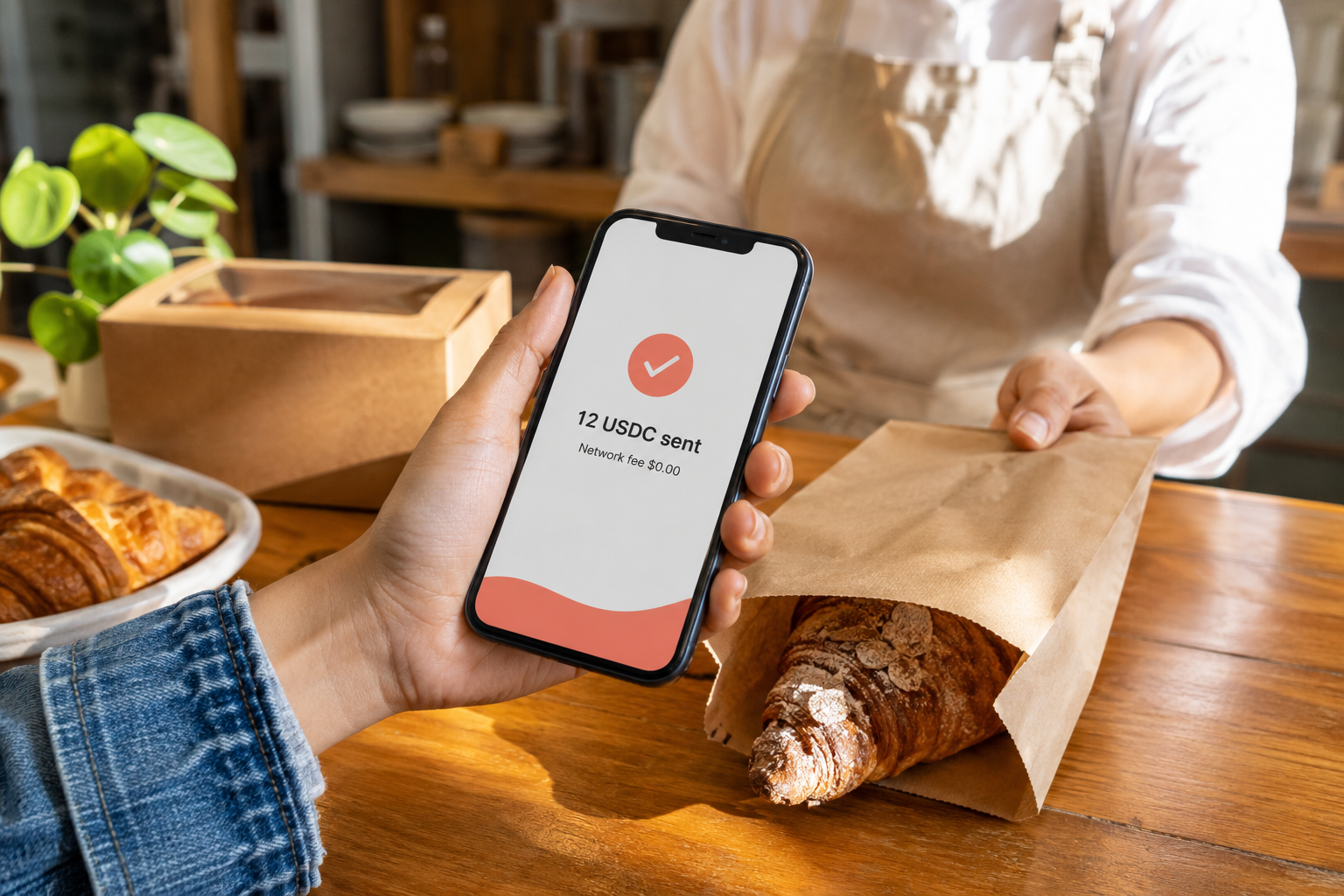
StableClerk is building business payments software for companies that want to send, receive, and manage global USDC payments from self-custodied wallets without learning crypto.
“Cryptocurrency has saved billions of dollars for large businesses by cutting out banking fees and FX spreads on cross-border payments. For everyone else, blockchain's benefits have remained out of reach until now," says John Roberts, CEO of StableClerk.
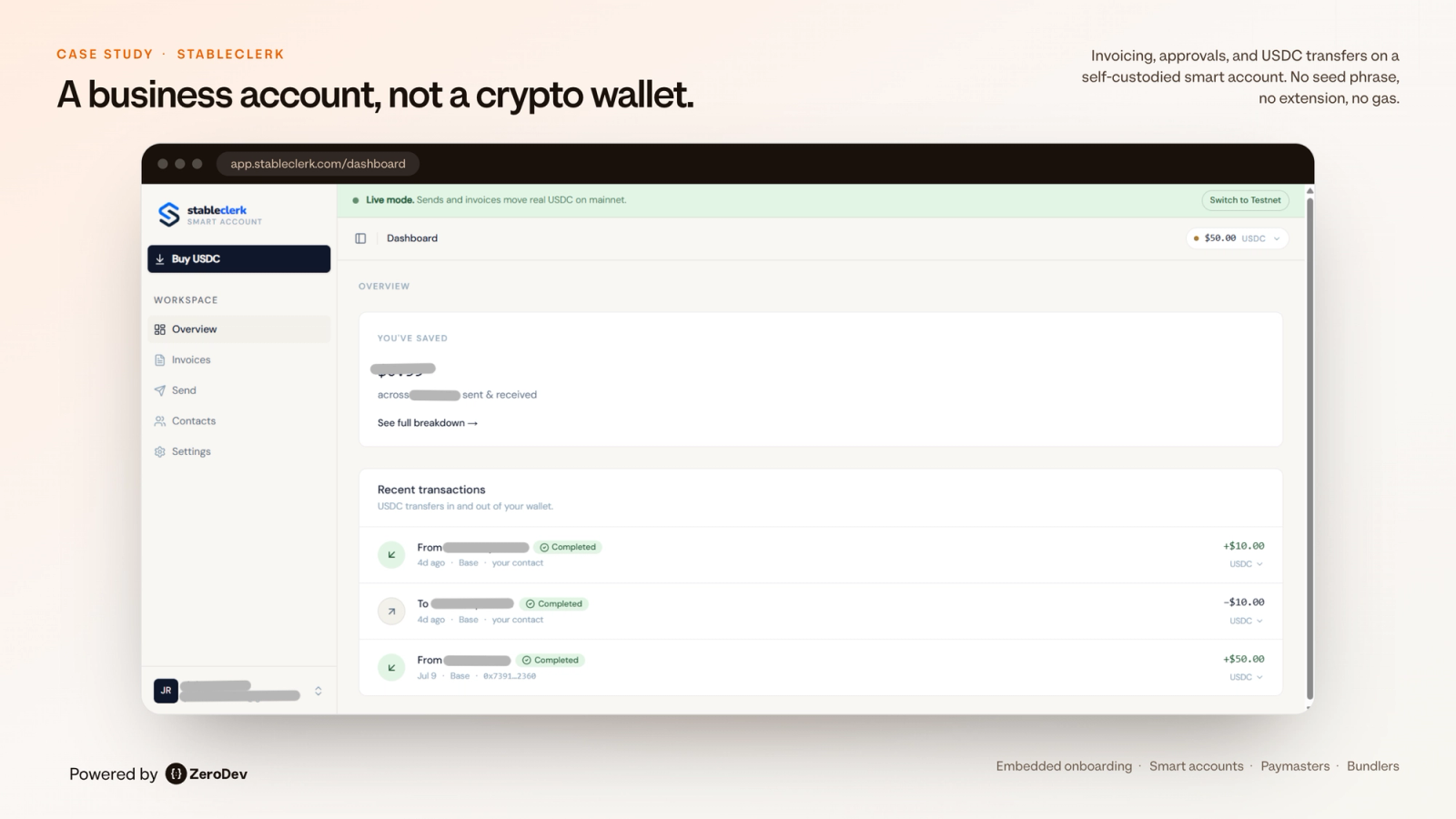
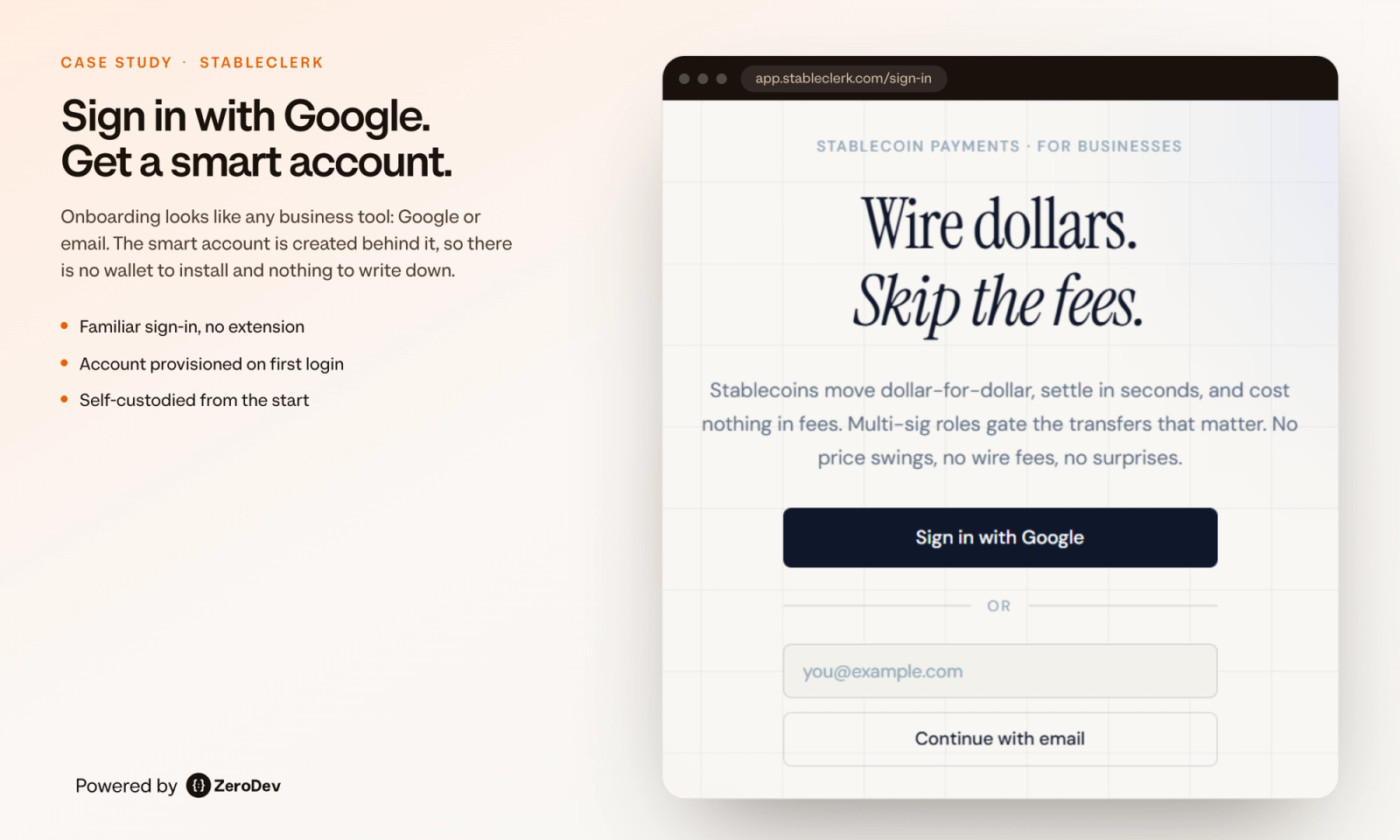
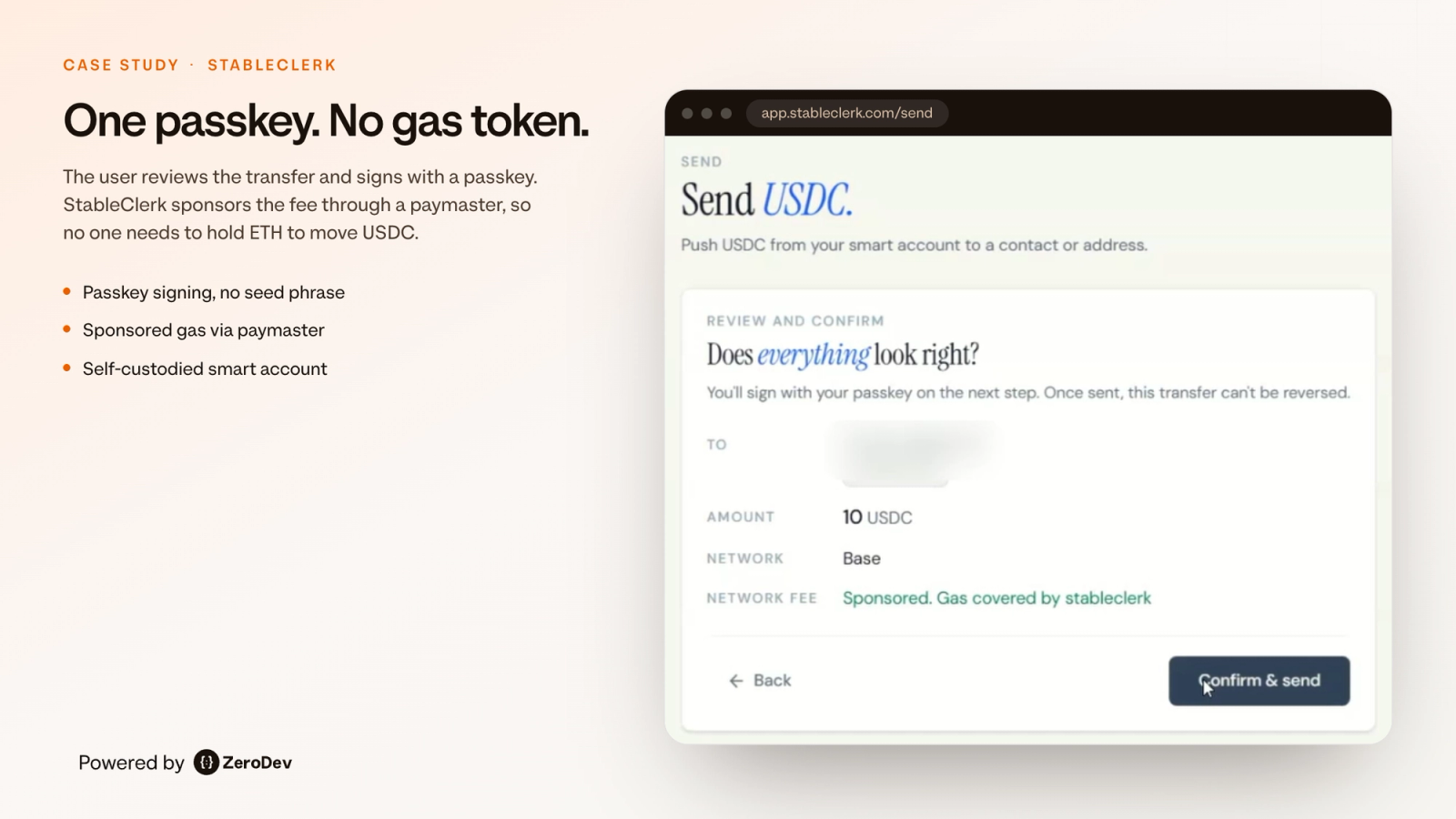
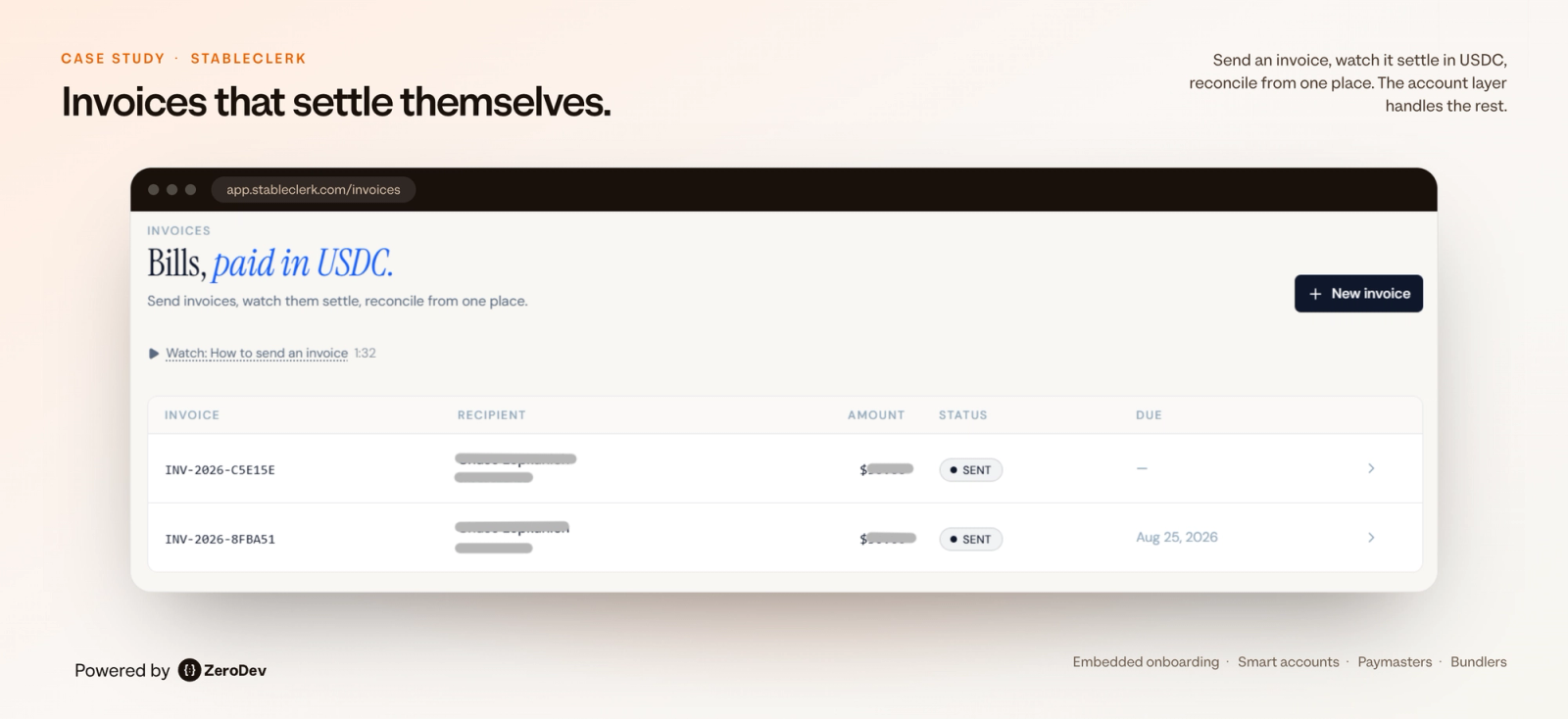
With ZeroDev Wallet, StableClerk gives each customer a smart account that feels like a business payments account, not a standalone crypto wallet. Users can onboard with Google or email, create invoices, approve payments, send USDC, review transactions, and manage reporting without handling seed phrases, browser extensions, gas fees, network selection, or blockchain-specific signing flows.
ZeroDev provides the embedded wallet onboarding, ERC-4337 smart accounts, paymasters, and gas-sponsored transaction infrastructure behind the experience. That lets StableClerk focus on the product layer: custom invoicing, payment workflows, dashboard reporting, and StableNetwork, the company’s identity layer facilitating faster payments between verified parties.
“StableClerk abstracts away the complexity of crypto so businesses can manage their money without worrying about excessive fees or conversion rates,” added John Roberts. “Powered by ZeroDev, our self-custodied smart wallets feel like a native part of our product instead of a separate crypto experience.”
Case Study Snapshot
Customer: StableClerk
Use case: Self-custodied USDC payments for businesses
Product experience: Invoicing, payment approvals, transaction history, counterparty verification, reporting, and USDC movement
ZeroDev products used: Embedded wallet onboarding, smart accounts, paymasters, and gas sponsorship
Key outcome: Faster product development, less wallet infrastructure to maintain, and a cleaner business payments UX
User experience: Google or email onboarding, no seed phrases, no browser extension, and no gas management required
The Challenge: Bringing Stablecoin Payments to Businesses Without Crypto Complexity
StableClerk is built for businesses that want faster, lower-cost global payments without giving up control of their funds. After onboarding, each customer receives a self-custodied smart account for sending and receiving USDC. From the user’s perspective, the experience is much closer to business banking than a crypto wallet.
Users can create invoices, approve payments, review transaction history, and manage payment workflows from a familiar dashboard. They do not need to manage seed phrases, install browser extensions, choose networks, pay gas, or understand blockchain transaction flows.
That meant StableClerk needed to build a platform with a wallet infrastructure that could stay mostly invisible.
Without ZeroDev, the team would have needed to assemble embedded authentication, signer management, ERC-4337 smart accounts, bundlers, paymasters, gas abstraction, transaction relaying, recovery flows, and permission tooling. For a small team, that was the wrong place to spend engineering time.
John Roberts commented: “We want to build a stablecoin network that caters to businesses, not a wallet stack.”
Why Stablecoin Payments Need Embedded Wallet Infrastructure
Stablecoin payments are becoming more relevant for businesses that need faster global settlement, lower cross-border payment friction, and secure, stable and liquid funds. Yet despite its evident benefits, adoption still varies.
StableClerk’s approach is to hide the crypto-specific steps that usually slow business users down and to build on top of blockchain infrastructure to coordinate programmable payment workflows. This requires self-custody account infrastructure that offers a familiar fintech experience to non crypto-native users.
Why StableClerk Chose ZeroDev Wallet
StableClerk chose ZeroDev because it brought embedded wallet onboarding and smart account infrastructure into one account stack.
That mattered for both user experience and engineering complexity.
Instead of stitching together separate providers for authentication, smart accounts, relaying, gas sponsorship, and session key management, StableClerk could build on a unified system. That reduced vendor decisions, simplified architecture, and gave the team more confidence in the wallet layer behind the product.
It also helped preserve the UX StableClerk’s platform requires: a business account experience, not a crypto wallet experience.
“The biggest benefit of ZeroDev,” opined Paul Kim, StableClerk’s Chief Technology Officer, “is collapsing multiple infrastructure dependencies into one coherent smart account system.”
What ZeroDev Replaced in StableClerk’s Wallet Stack
Without ZeroDev, StableClerk would have needed to build and maintain large parts of the account abstraction stack in-house.
ZeroDev removed the need to separately operate:
- Embedded wallet onboarding
- ERC-4337 smart accounts
- Bundlers
- Paymasters
- Transaction relaying
- User operation validation
- Gas sponsorship logic
- Custom smart wallet contracts
- Signer and wallet lifecycle infrastructure
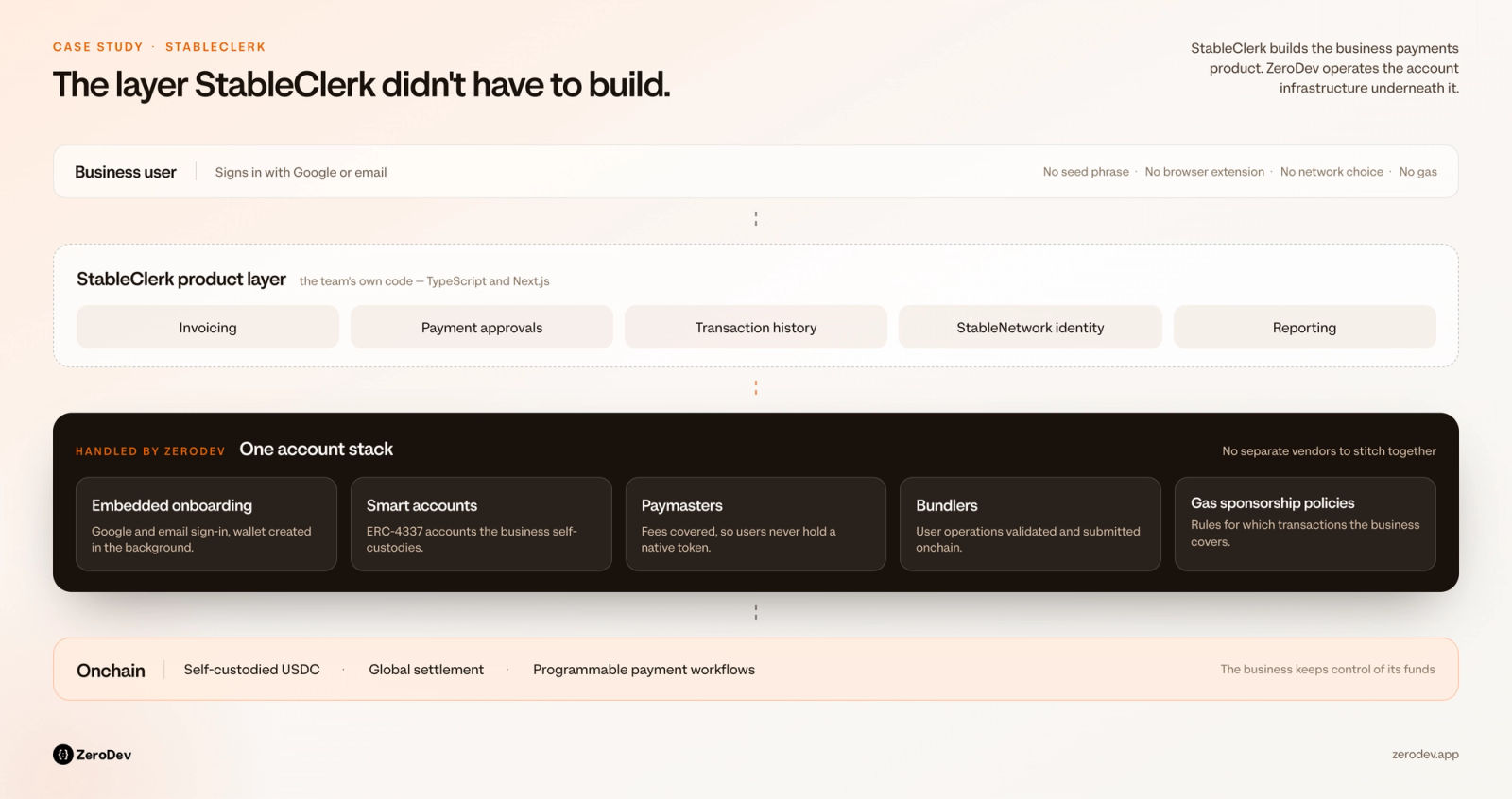
That reduced the amount of sensitive wallet logic StableClerk needed to manage directly and let the team keep more engineering attention on the business payments product.
How StableClerk Integrated ZeroDev Wallet
StableClerk built its application in the TypeScript and Next.js ecosystem, which made ZeroDev a natural fit for the product architecture.
The team uses ZeroDev Wallet for Google and email authentication, smart accounts, and paymasters. Because the account and wallet logic did not need to live inside StableClerk’s own infrastructure, the team had less wallet lifecycle complexity to own directly.
The team did run into some early issues while working with a new wallet library, but ZeroDev’s team responded quickly with updates. Documentation and script examples also helped with more specific flows, including private key export.
“A ton of hours were saved by us not having to build our own infrastructure, and a lot of mental bandwidth as well by not having to maintain additional services ourselves,” recalled Paul Kim.
The Developer Experience: More Focus on Payments, Less Wallet Infrastructure
For StableClerk, the biggest developer experience win was not just speed. It was focus.
ZeroDev let the team spend more time building the business payments product and less time maintaining non-custodial wallet infrastructure.
Authentication was effectively part of the wallet flow. Smart accounts and paymasters were available without separate infrastructure decisions. The team could keep the complexity of account abstraction behind the scenes while still building on programmable accounts.
That is especially important for a product where conversion depends on reducing friction.
If onboarding feels like crypto, users may never reach the payment and invoicing workflows where StableClerk delivers value. ZeroDev helped StableClerk keep the wallet experience simple enough for businesses while preserving the self-custody and programmability benefits of onchain accounts.
What StableClerk Can Build Next With Programmable Smart Accounts
StableClerk’s roadmap depends on programmable accounts.
The team plans to build ERC-4337-compatible smart contracts for business payment use cases that are difficult to support with traditional wallet flows. One example is subscription-style payments, where merchants can support recurring payment flows that feel closer to card-based billing while still using stablecoin rails.
StableClerk is also looking ahead to agentic payment infrastructure and expects more granular paymaster controls to become important for preventing abuse as the platform grows.
ZeroDev gives the team a foundation for these future workflows without forcing users to understand the infrastructure underneath.
The Result: A Cleaner Business Payments UX for Self-Custodied USDC
The most important outcomes are product velocity, reduced infrastructure scope, and a cleaner user experience. StableClerk’s partnership with ZeroDev unlocks cryptocurrency for businesses, often for the first time. Once users create an account, businesses can send and receive USDC payments in a familiar setting. That product experience is critical for helping businesses understand what stablecoin payments can feel like when the wallet layer is abstracted away.
“Without ZeroDev, we would have had to stitch together separate providers for smart accounts, transaction relaying, and gas sponsorship, while also building significant parts of the wallet stack in-house,” remarks Paul Kim.
For StableClerk, ZeroDev Wallet turned self-custodied smart accounts into product infrastructure. The wallet is still there, but it does not dominate the user experience.
That is the point.
Businesses get ownership, programmable accounts, and USDC payments. StableClerk gets to build the workflows that make those payments useful.
Build embedded smart accounts for stablecoin payments with ZeroDev.
Related articles
How Nika Makes Onchain Trading Feel Like One Product
Nika uses ZeroDev’s account abstraction and gas sponsorship infrastructure to unify spot markets, perpetuals, yield, and more into one non-custodial trading experience without exposing users to blockchain complexity.
How walllet.com Powered 100K+ Smart Accounts with ZeroDev
See how walllet.com used ZeroDev’s smart account infrastructure, passkeys, and gas sponsorship to eliminate onboarding friction and surpass 100,000 wallet creations.

A Simple Way to Move Money Using Powerful Tools
Peanut Protocol leveraged ZeroDev’s account abstraction to replace complex seed phrases with biometric FaceID logins. By implementing gas sponsorship and Smart Routing, they transformed a 7-step 'old crypto' headache into a seamless 1-click payment flow, now powering over 5 million accounts.

Go from wallet friction to product velocity
If your team is blocked on account UX, gas, or chain complexity, ZeroDev gives you a practical place to start.