





Case Studies
How Nika Makes Onchain Trading Feel Like One Product
September 24, 2026

Executive Summary
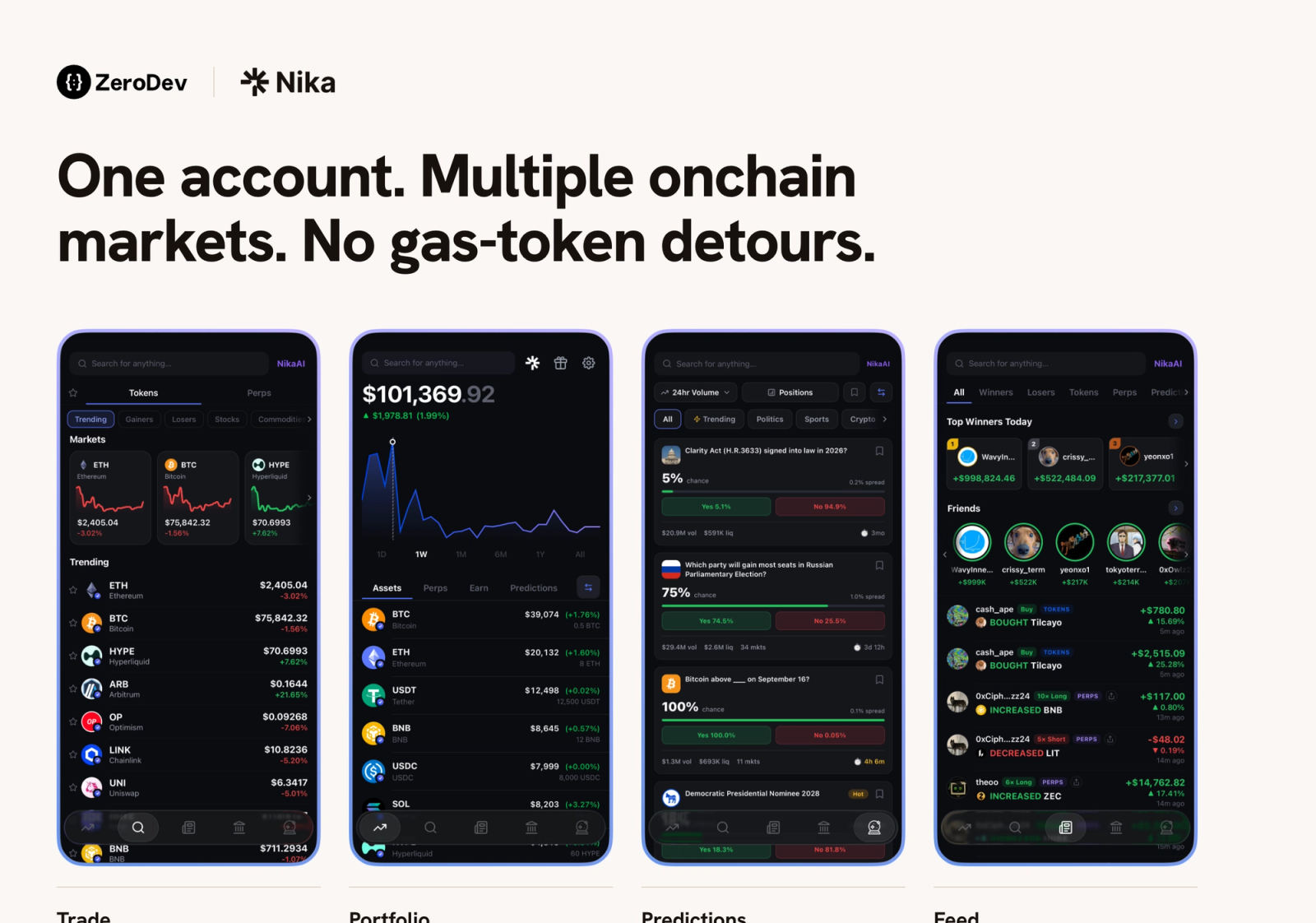
Nika is building a unified, non-custodial trading experience that brings spot markets, perpetuals, yield opportunities, prediction markets, and other onchain products into a single account.
The product thesis is straightforward: onchain finance can offer a better financial experience than traditional platforms, but only when the infrastructure disappears into the product. Users should be able to buy an asset, open a position, deposit funds, or earn yield without first becoming experts in gas tokens, network fees, or EVM transaction mechanics.
ZeroDev provides the account abstraction and gas sponsorship infrastructure behind that experience. By handling key parts of transaction execution below the interface, ZeroDev helps Nika design around user intent instead of blockchain constraints.
Key takeaway
"The best blockchain UX is when the user doesn't have to think about the blockchain at all. ZeroDev helps us get closer to that." Daniel Brinzan, Founder, Nika Finance
The Opportunity
Nika is designed to bring fragmented onchain markets into one consumer experience. Instead of asking users to navigate separate protocols, chains, and wallets, Nika gives them one place to trade, invest, earn, and manage positions while remaining in control of their funds.
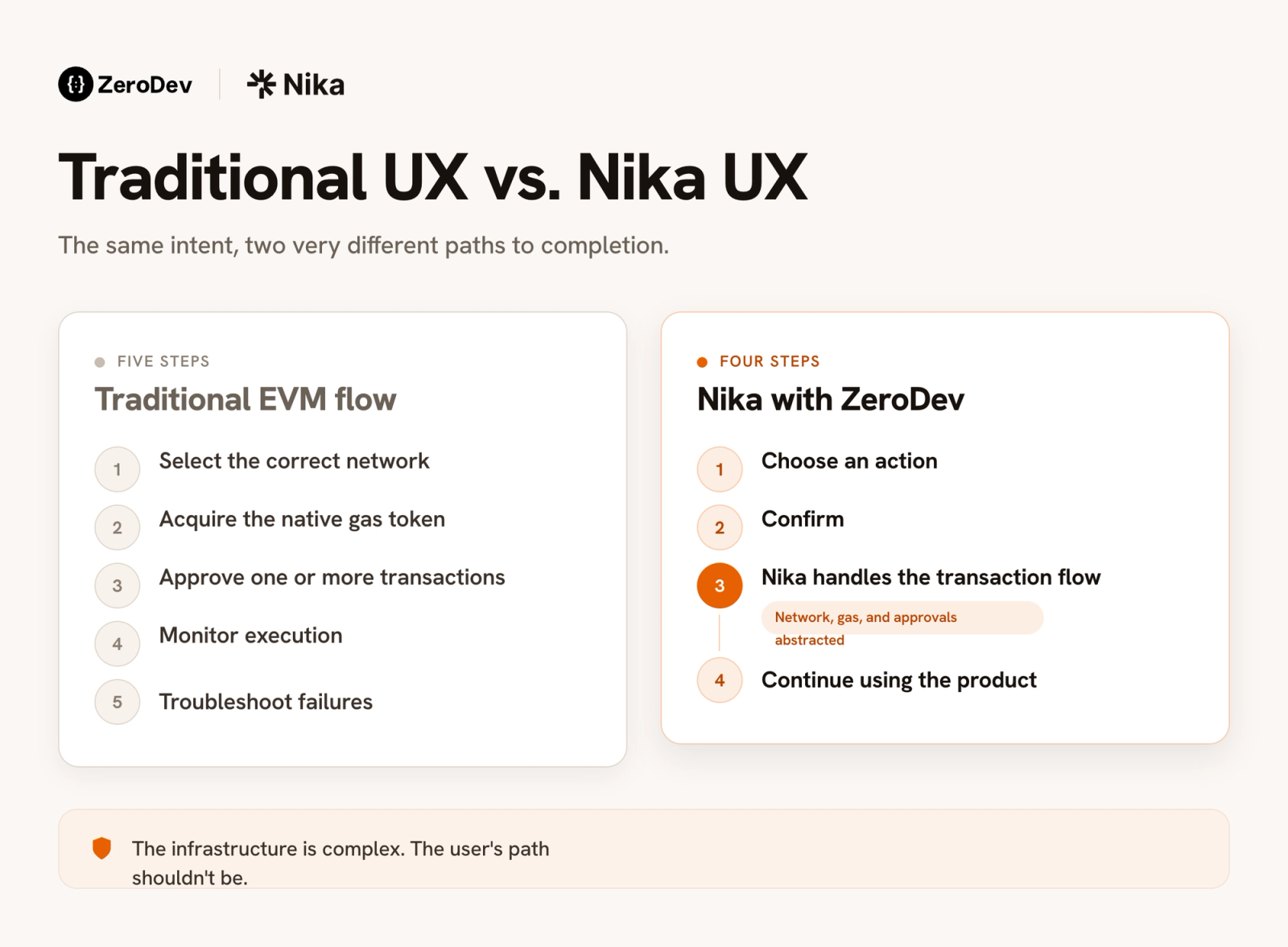
That ambition creates an infrastructure challenge. In the traditional EVM model, users are expected to maintain the right wallet, hold the native token for gas, understand which network they are using, approve multiple transactions, and troubleshoot failures when something goes wrong.
For an experienced crypto user, those steps may be familiar. For a mainstream user, they are product friction. Each blockchain-specific decision interrupts the action the user originally came to complete.
Nika wanted to move in the opposite direction: the user expresses an intent, and the application handles as much of the transaction complexity behind that intent as possible. Removing this friction was not a convenience feature. It was core product infrastructure.
The Solution
Nika integrated ZeroDev into its EVM transaction infrastructure to support account abstraction, sponsored transaction flows, and onchain execution.
From the user's perspective, actions inside Nika can behave more like normal application interactions. Users do not need to stop mid-flow, acquire a network's native gas token, and return to the trade or deposit they were trying to complete.
For the Nika team, ZeroDev turns transaction execution and gas sponsorship into infrastructure rather than product constraints. That gives the team more control over the transaction experience while keeping engineering focus on Nika's differentiated trading product.
Why ZeroDev
Account abstraction can look simple from the outside. In production, it involves infrastructure reliability, sponsorship policies, transaction execution, cross-chain edge cases, and standards that continue to evolve.
Building and maintaining that layer internally would have required Nika to dedicate engineering resources to infrastructure outside its core differentiation. ZeroDev gave the team a production-focused account abstraction layer and implementation resources, allowing those resources to stay focused on the Nika product.
How ZeroDev Fits Into Nika's Architecture
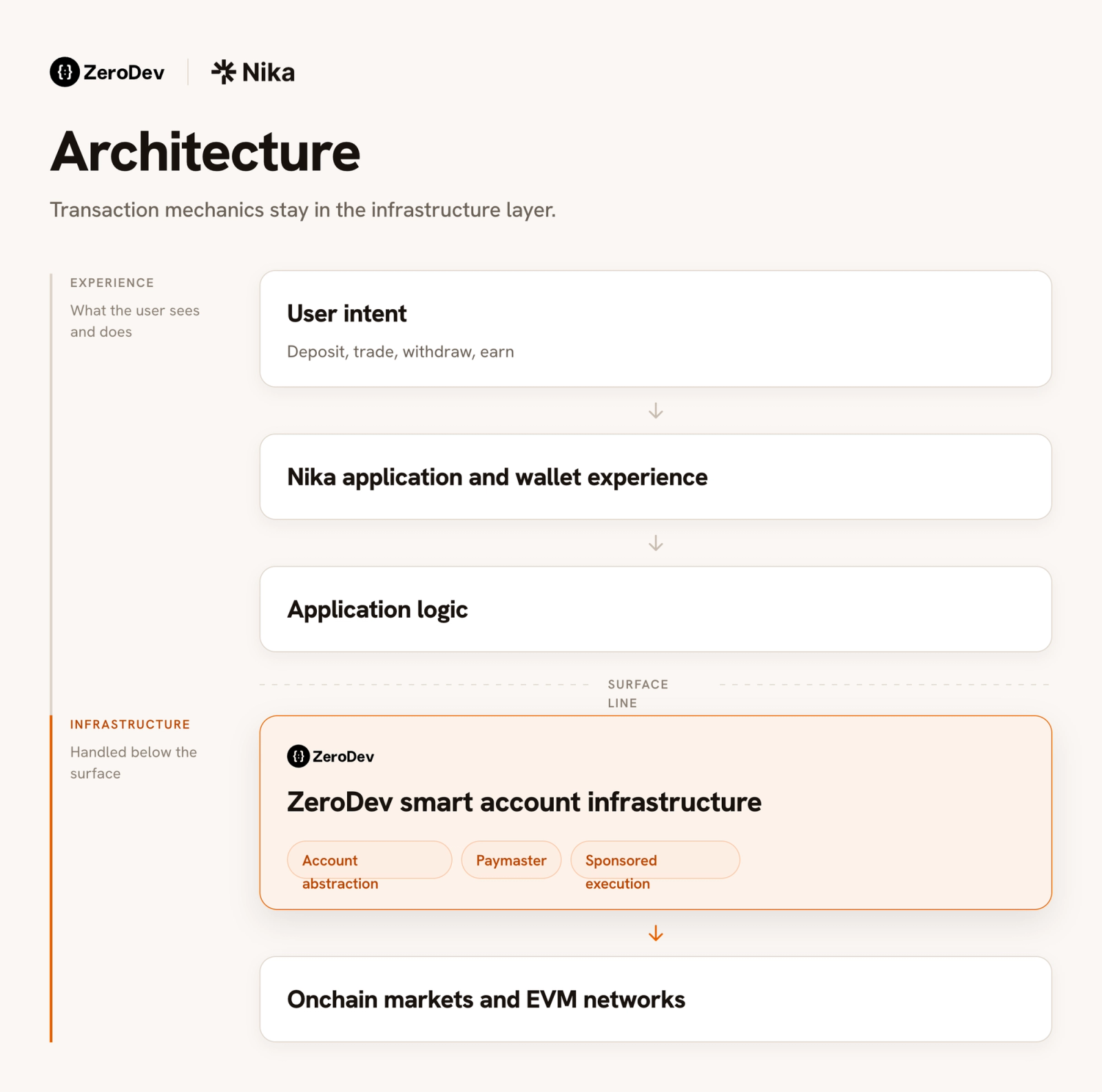
ZeroDev sits in the transaction infrastructure layer between Nika's user-facing wallet experience and onchain execution.
The user interacts with Nika to deposit, trade, withdraw, or earn. Nika's application logic prepares the intended action. ZeroDev's smart account and paymaster infrastructure helps abstract account behavior, gas sponsorship, and transaction execution before the action reaches the underlying chain.
This separation matters because it lets Nika start with the ideal user journey, then use infrastructure to make that journey possible. The mechanics remain available to the product team without being pushed onto the user.
Implementation Overview
Nika primarily uses ZeroDev's account abstraction infrastructure for gas sponsorship and EVM transaction execution. ZeroDev's smart account tooling supports sponsored UserOperations, while configurable gas policies give teams control over what they sponsor and how much.
The main integration challenge was not adding account abstraction in isolation. It was making the behavior consistent across wallet infrastructure, application logic, different transaction types, and the edge cases that appear in production.
ZeroDev's documentation and implementation resources reduced the amount of specialized account abstraction infrastructure Nika needed to reason about and build internally. More importantly, the integration lets the product team treat gas as an implementation detail rather than a step in the user journey.
Impact
Nika does not isolate ZeroDev's contribution through an A/B metric because gas abstraction is part of the underlying product experience, not an optional feature.
The clearest engineering impact is avoided build and maintenance cost. Nika can rely on infrastructure dedicated to sponsorship policies, smart account execution, and evolving account abstraction standards rather than owning the full stack internally.
For users, the qualitative impact is simpler: fewer moments that expose blockchain infrastructure. That is especially important for an application built for people who care about markets and trading opportunities, not necessarily wallets, gas, and EVM architecture.
The comparison is not provider A versus provider B. It is traditional blockchain UX versus application-abstracted blockchain UX. Every requirement to source a gas token, choose a network, or understand execution mechanics adds another decision and another potential failure point. Account abstraction lets Nika remove many of those decisions entirely.
Lessons for Other Builders
If you are building a consumer-facing onchain application, treat account abstraction as product infrastructure, not just a wallet feature.
Start with the experience you would design if blockchain limitations did not exist. Then identify the infrastructure needed to support it: sponsored transactions, programmable account behavior, transaction batching, permissions, or cross-chain execution.
The strongest account abstraction decisions are the ones users never need to notice. The technology is doing its job when the product feels clear, predictable, and focused on the outcome the user wants.
What's Next
Nika is continuing to expand both the products users can access and the ways they can interact with markets. Upcoming priorities include iOS and Android apps, social and copy trading, Nika AI v2, and additional trading and investing experiences across the platform.
As Nika expands across more markets, products, and chains, account abstraction becomes even more important. The broader goal remains the same: give users access to increasingly powerful onchain financial products while making the underlying infrastructure progressively less visible.
Explore
Related articles
How walllet.com Powered 100K+ Smart Accounts with ZeroDev
See how walllet.com used ZeroDev’s smart account infrastructure, passkeys, and gas sponsorship to eliminate onboarding friction and surpass 100,000 wallet creations.
How StableClerk Uses ZeroDev Wallet for Self-Custodied USDC Payments
See how StableClerk uses ZeroDev Wallet to deliver self-custodied USDC payments with simple onboarding, sponsored gas, and no crypto complexity.

A Simple Way to Move Money Using Powerful Tools
Peanut Protocol leveraged ZeroDev’s account abstraction to replace complex seed phrases with biometric FaceID logins. By implementing gas sponsorship and Smart Routing, they transformed a 7-step 'old crypto' headache into a seamless 1-click payment flow, now powering over 5 million accounts.

Go from wallet friction to product velocity
If your team is blocked on account UX, gas, or chain complexity, ZeroDev gives you a practical place to start.