




Developers
How to Design Cross-Chain Wallet Funding Without Manual Bridging
August 4, 2026

Wallet creation is getting easier. Funding a wallet is still where the product experience often breaks.
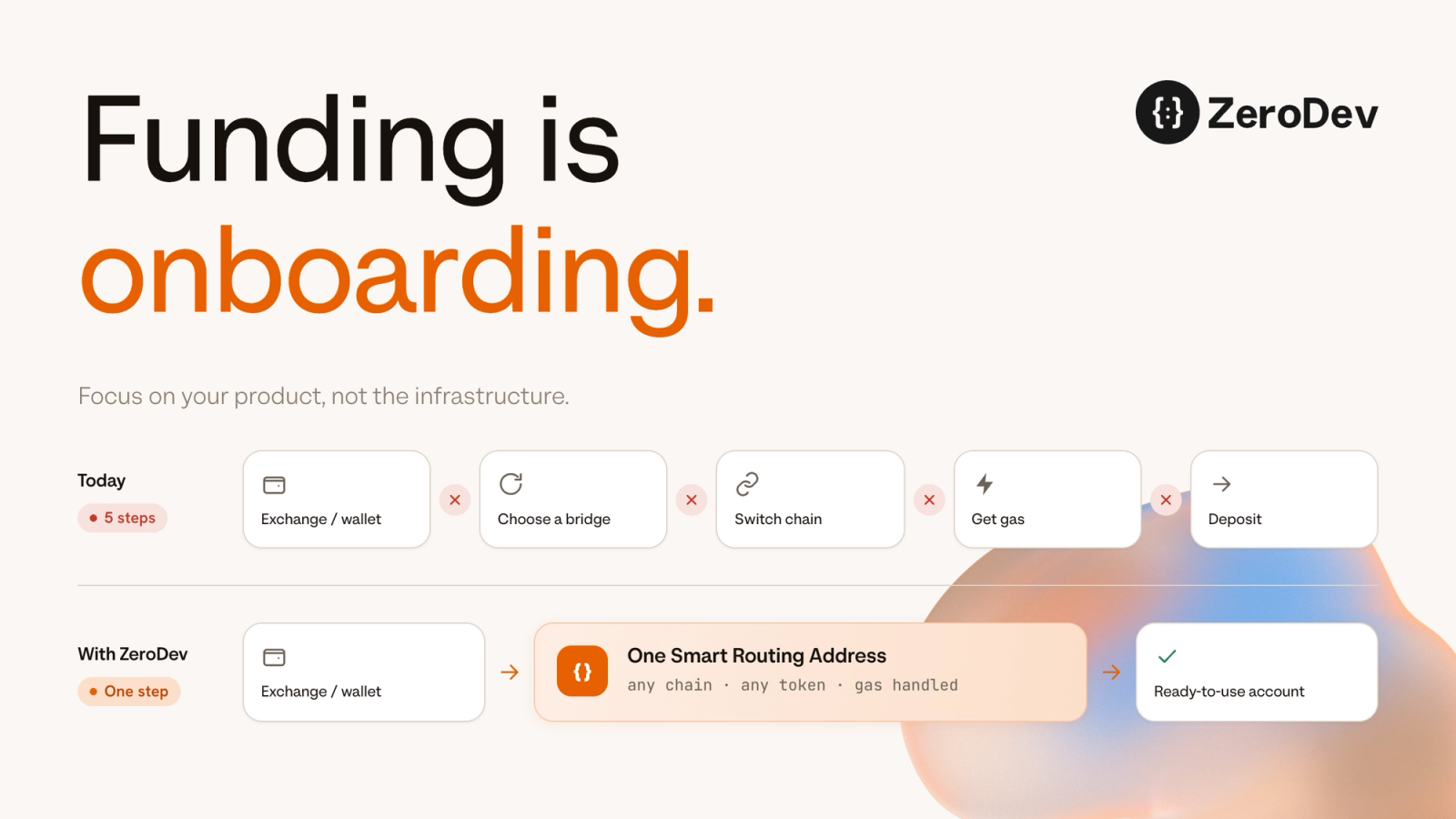
A user can sign in with an email, create a smart account, and reach a polished dashboard within seconds. But when they select Deposit, they may suddenly encounter all the infrastructure the onboarding flow worked to hide: source and destination networks, token compatibility, bridging, gas fees, transfer times, and recovery procedures.
That is why the first deposit is a better onboarding benchmark than wallet creation. Creating an account proves authentication works. Funding it proves the product works.
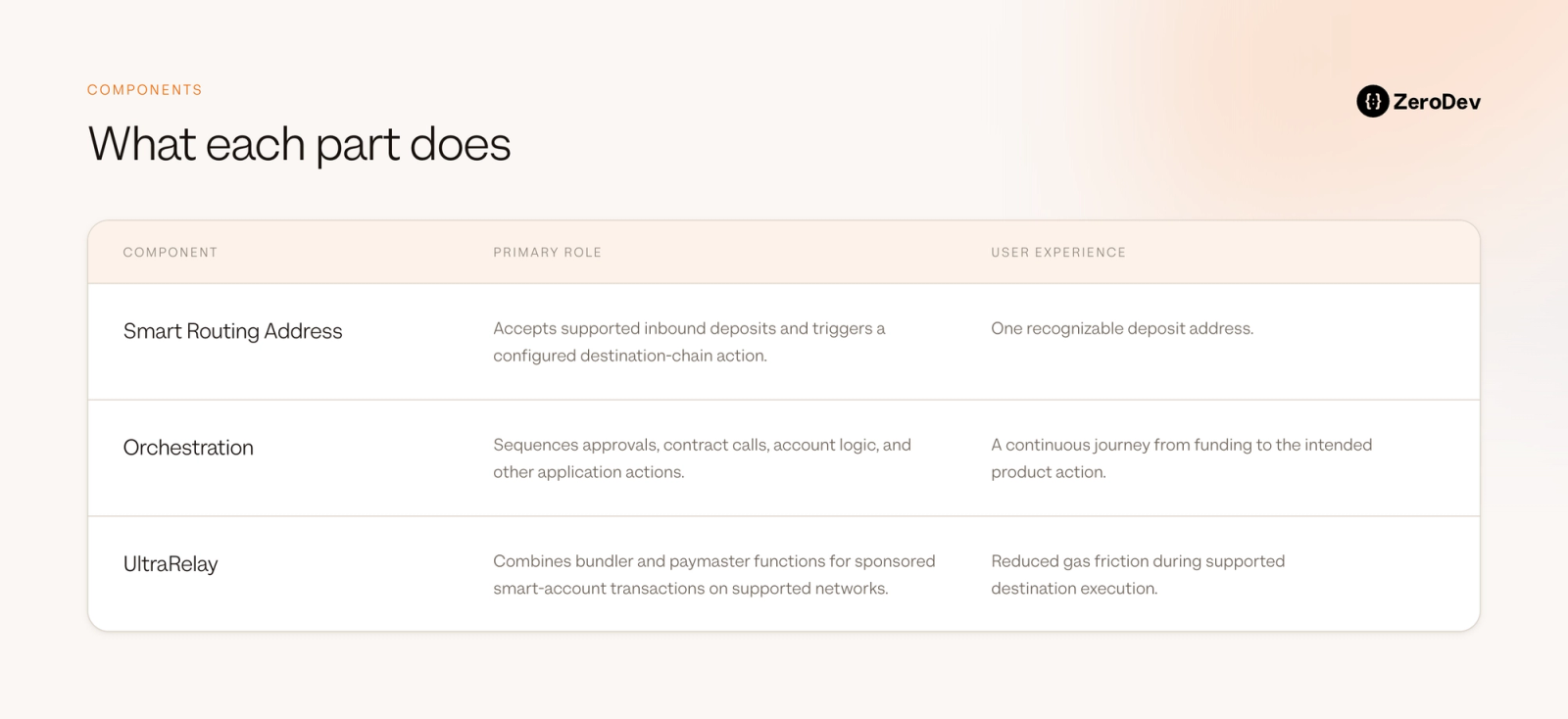
A well-designed cross-chain wallet funding flow gives each user one recognizable deposit destination, defines the supported source chains and tokens, routes funds to the required destination chain behind the interface, and tracks progress until the funds are usable. With ZeroDev, Smart Routing Address can handle the inbound cross-chain deposit, while orchestration and UltraRelay can support the actions that follow.
Why the First Wallet Deposit Is the Real Onboarding Test
An empty wallet is not an activated account.
Until funds reach the account in the right asset, on the right chain, and in a usable state, the user cannot complete the action that brought them to the product. They cannot trade, save, stake, make a payment, or enter a position.
The first deposit is therefore part of the core product journey, not an infrastructure task that should simply be handed off to an external bridge.
The experience should begin with the user’s intent:
I want to put $100 into this account.
It should not begin with a network menu that requires the user to understand the application’s routing architecture before they can use the product.
Network selection may still be necessary somewhere in the system, but it should not define the experience.
What Makes Cross-Chain Wallet Funding Difficult?
A deposit may appear to be a single transfer. In a cross-chain environment, however, it is a coordinated workflow involving six variables.
Source
Where are the funds currently held?
They may be on a centralized exchange, in another wallet, on another blockchain, or with a fiat onramp.
Destination
Where must the funds become usable?
The destination might be a smart account on a specific Layer 2 network, an appchain, or a contract such as a vault.
Token
What asset is the user sending, and what asset does the application need to receive?
The source and destination assets may not always be the same.
Route
Which supported bridge, swap, or solver path can move value between the source and destination states?
Gas
Who pays for execution, which asset covers the cost, and on which chain is the fee charged?
Execution
Should the destination account simply receive the funds, or should the deposit trigger another action?
A conventional deposit flow exposes many of these decisions directly to the user. The user may need to:
- Withdraw funds on a specific network.
- Connect a separate wallet.
- Open a bridge.
- Choose a destination network.
- Approve a token.
- Wait for the transfer.
- Return to the original application.
Each step may be reasonable at the protocol level. Combined, they create a fragmented product experience.
Why Hiding the Chain Picker Is Not Enough
Removing network selection from the interface does not eliminate fragmented wallet funding.
If the application still generates a different deposit address for every route, requires a specific token without clearly explaining why, or sends users to an external bridge, the underlying complexity remains. It will reappear through confusing instructions, errors, support tickets, and abandoned deposits.
Real chain abstraction requires a stable account surface.
The user should be able to recognize one deposit destination associated with the product. Behind that destination, the application can:
- Validate the source chain and token.
- Select a supported route.
- Handle cross-chain execution.
- Deliver the configured asset or action to the intended account.
- Track the transfer through destination completion.
The interface becomes simpler because the funding model is more coherent, not merely because more controls are hidden.
What Is a Smart Routing Address?
A Smart Routing Address is a unique deposit address representing a configured cross-chain intent.
A user sends a supported token to the address from a supported source chain. The routing flow then triggers a configured action on a specific destination chain.
The address is source-chain agnostic within its supported configuration, but it remains destination-chain specific. Only source tokens included in the configuration trigger the intended destination action. Sending an unsupported token may require manual recovery.
How a Routed Cross-Chain Deposit Works
A routed deposit can be organized into five stages.
1. Configure the Deposit Route
The application defines:
- The destination chain.
- Accepted source chains and tokens.
- The destination action.
- The recovery owner.
- The applicable slippage policy.
These configuration choices determine which deposits can trigger the intended cross-chain action.
2. Present One Recognizable Deposit Address
The user selects an accepted asset and copies or scans a single deposit address associated with the product.
Supported token-and-network combinations should appear close to this action so users do not assume every asset and network is accepted.
3. Detect the Source Transfer
The user sends funds from a supported exchange, wallet, onramp, or source chain.
Once the source transaction is detected, the application begins displaying its progress.
4. Execute the Configured Destination Action
The routing intent processes the deposit and triggers the configured action on the destination chain.
Depending on the product, this could deliver funds to a smart account or initiate another supported application action.
5. Confirm That the Funds Are Usable
The application tracks the route until the funds or destination action are available to the user.
Developers still make routing decisions. Those decisions belong in product configuration and observable routing logic, where they can be tested, monitored, and changed. They do not need to become a checklist that every user must complete.
Smart Routing Address vs. UltraRelay
Smart Routing Address handles inbound funding. The account stack determines what happens after the funds arrive.
Keeping these roles distinct makes the architecture easier to explain, operate, and debug.
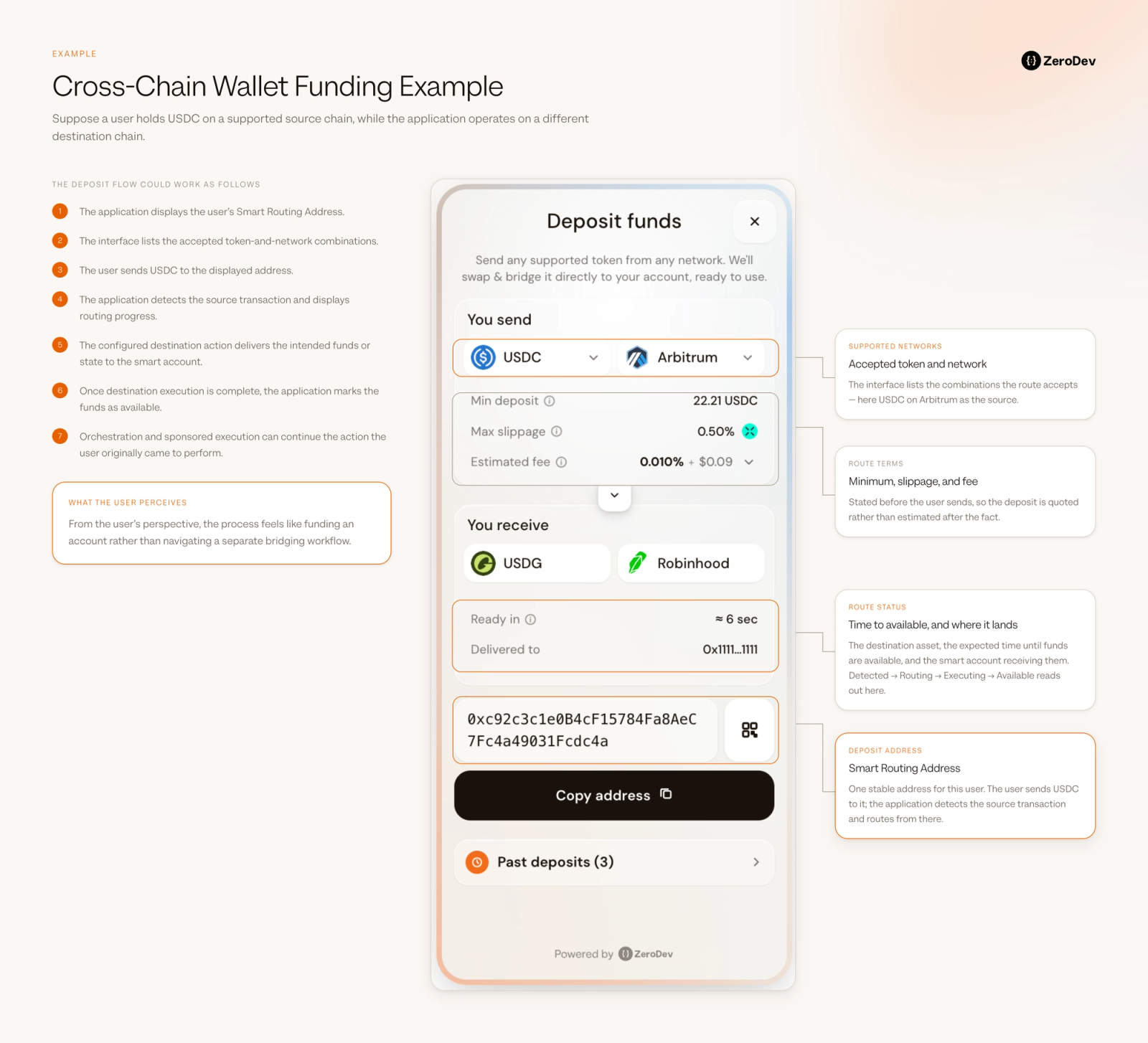
Cross-Chain Wallet Funding Example
Suppose a user holds USDC on a supported source chain, while the application operates on a different destination chain.
The deposit flow could work as follows:
- The application displays the user’s Smart Routing Address.
- The interface lists the accepted token-and-network combinations.
- The user sends USDC to the displayed address.
- The application detects the source transaction and displays routing progress.
- The configured destination action delivers the intended funds or state to the smart account.
- Once destination execution is complete, the application marks the funds as available.
- Orchestration and sponsored execution can continue the action the user originally came to perform.
From the user’s perspective, the process feels like funding an account rather than navigating a separate bridging workflow.
How to Handle Cross-Chain Deposit Delays and Failures
Cross-chain routing is asynchronous. A confirmed source transaction does not necessarily mean the destination balance is ready to use.
The interface should distinguish source confirmation from destination completion and provide explicit guidance when a route encounters a problem.
Show Clear Deposit Lifecycle States
Instead of using one indefinite Pending state, display meaningful milestones such as:
- Transfer detected
- Route in progress
- Destination execution submitted
- Funds available
Add timestamps and transaction references when they help users or support teams understand what is happening.
Validate Minimum Deposit Amounts
A small transfer may not cover routing costs or satisfy the application’s minimum deposit requirement.
When the source supports quoting, validate the minimum before the user sends funds. If pre-validation is not possible, display the minimum clearly and explain how undersized deposits will be handled.
Identify Unsupported Sources and Tokens
A familiar deposit address can create the impression that every asset on every network is accepted.
Keep supported token-and-network combinations close to the deposit action. Retrieve this information from the product configuration rather than maintaining separate interface copy that can become outdated.
Only configured source tokens trigger the intended destination action. The interface should never imply universal compatibility when unsupported tokens may require manual recovery.
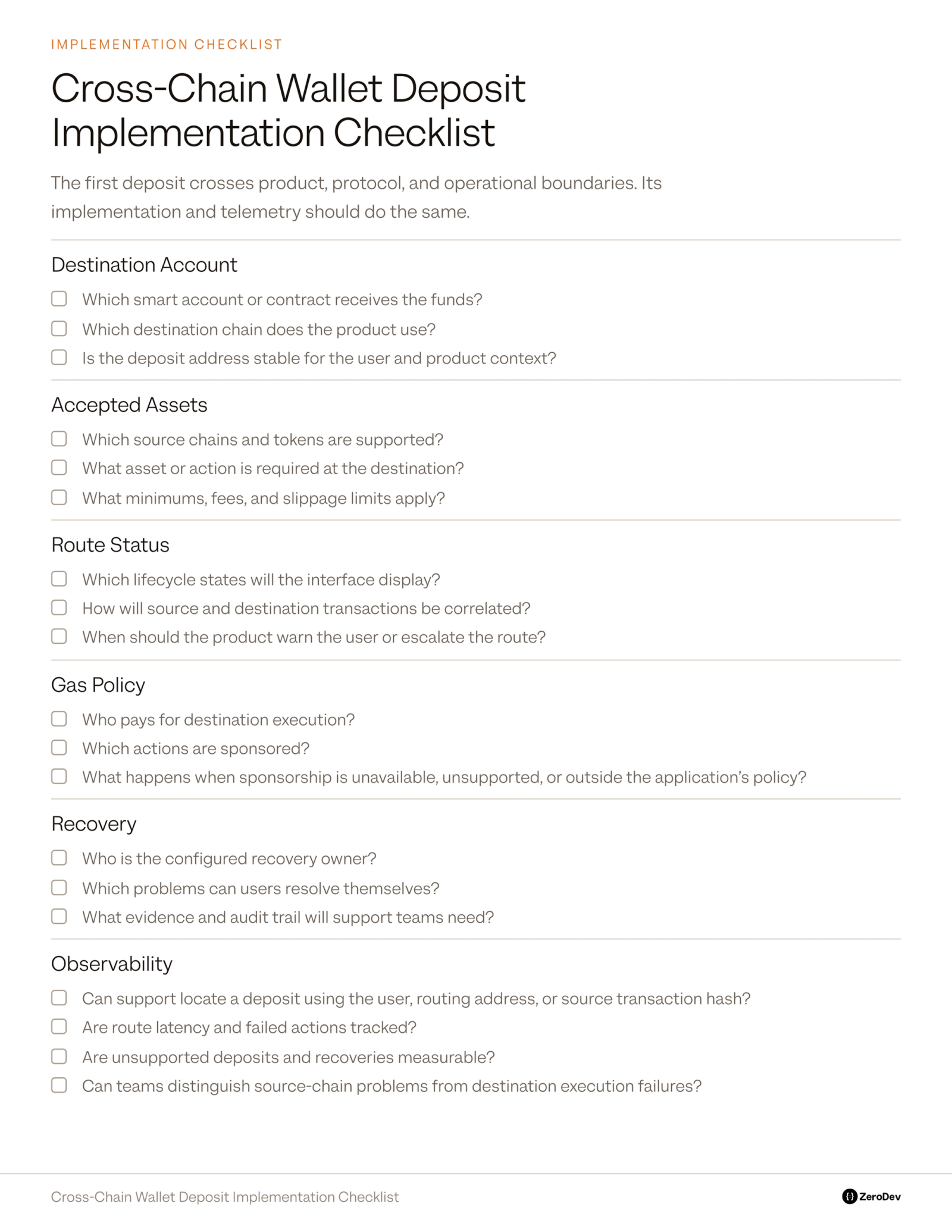
Design Refund and Recovery Workflows in Advance
Recovery should be a defined product workflow, not an escalation process created after funds become stuck.
Teams should determine:
- Who is authorized to recover funds.
- Which conditions make a deposit recoverable.
- Whether recovery is self-service or assisted.
- Where recovered funds will be sent.
- Which status the user sees during recovery.
- What evidence and audit trail support teams can access.
ZeroDev’s configuration includes an owner authorized to recover funds when the target action cannot execute. Its portal also supports retrieval when an incorrect token is sent. These mechanisms still require clear interface states, support procedures, and audit trails.
Start With User Intent, Not Network Selection
Users do not fund an account because they want to bridge assets. They fund it because they want to trade, save, stake, pay, or enter a position.
Design the deposit experience around that intent:
- Provide one recognizable destination.
- Clearly publish supported routes.
- Show progress through destination completion.
- Make recovery part of the product.
- Continue the journey into the action the user originally intended to perform.
Smart Routing Address can provide the inbound funding surface. ZeroDev smart accounts, orchestration, gas policies, and UltraRelay can then carry the experience through supported destination execution.
Configure Your First Smart Routing Address
Define the destination chain, supported source tokens, destination action, recovery owner, and slippage policy using the Smart Routing Address quickstart.
Related articles

The EOA Transition: An In-Place Path to Native AA
ERC-4337 and Kernel proved that programmable accounts can work. The next step is native account abstraction that lets existing EOAs replace their root authorization without abandoning the address, assets, approvals, and history users already rely on.
Kernel v1–v4: What Production Kept and What It Left Behind
Across four versions, Kernel evolved from an EOA-shaped smart account into a modular foundation for replaceable validation, permissions, and EIP-7702. Its history reveals which account abstraction capabilities became durable products, and which still need better packaging.
ERC-4337 : Final, Not Finished
A builder’s retrospective on what ERC-4337 proved in production: less a path to mass smart-account migration, and more a shared rail for gas sponsorship, embedded onboarding, and programmable accounts.

Go from wallet friction to product velocity
If your team is blocked on account UX, gas, or chain complexity, ZeroDev gives you a practical place to start.