





Developers
How Smart Accounts Give Onchain AI Agents Safe Permissions
July 14, 2026

Autonomous AI agents are starting to act less like chat interfaces and more like participants in digital workflows.
They can evaluate context, choose tools, call APIs, initiate payments, purchase data, pay for compute, execute market actions, and coordinate across services. As these workflows become more capable, one question becomes harder to ignore:
How much onchain authority should an AI agent actually have?
The answer should not be: give the agent a private key and hope the prompt behaves.
Smart accounts make onchain AI agents safer by giving them scoped, revocable permissions instead of full wallet control. An agent can be allowed to call only approved contracts, spend only within defined limits, act only during a valid session, and lose access when the permission expires or is revoked.
Agents need the ability to act. They also need boundaries. Smart accounts make that possible by moving permissions, policy, and enforcement to the account layer.
What Is a Smart Account?
A smart account is a programmable onchain account controlled by smart contract logic instead of only a private key.
For agent workflows, that means the account can enforce rules before a transaction happens. Those rules can define:
- What actions the agent can take
- Which contracts or addresses it can interact with
- How much it can spend
- When its access starts or expires
- Whether gas must be sponsored or paid through a specific flow
- How access can be revoked
This gives teams a safer model for agentic execution. The agent can decide what action to request, but the smart account determines whether that action is allowed.
Prompts are probabilistic. Account policy can be deterministic.
Why Onchain AI Agents Need Scoped Authority
Most agent workflows today still sit one step away from economic activity. They recommend actions, prepare transactions, or ask a user to confirm the next step.
That will not be enough for many real-world use cases.
An agent that manages cloud resources may need to pay for compute. A research agent may need to buy data. A trading or prediction agent may need to act within defined market conditions. A consumer app agent may need to purchase a service, renew access, or complete an onchain interaction while the user is away.
As agents become more useful, they will need to transact.
Onchain infrastructure is a natural fit for these workflows because it gives agents access to programmable money, open services, transparent execution, and composable markets. But the same openness that makes onchain automation powerful also makes permissioning more important.
If an agent can move assets, call contracts, or trigger payments, teams need a clear way to define:
- What the agent can do
- Where it can do it
- How much it can spend
- When that authority ends
Why You Should Not Give an AI Agent a Private Key
An AI agent should not be given unrestricted private-key access to a wallet.
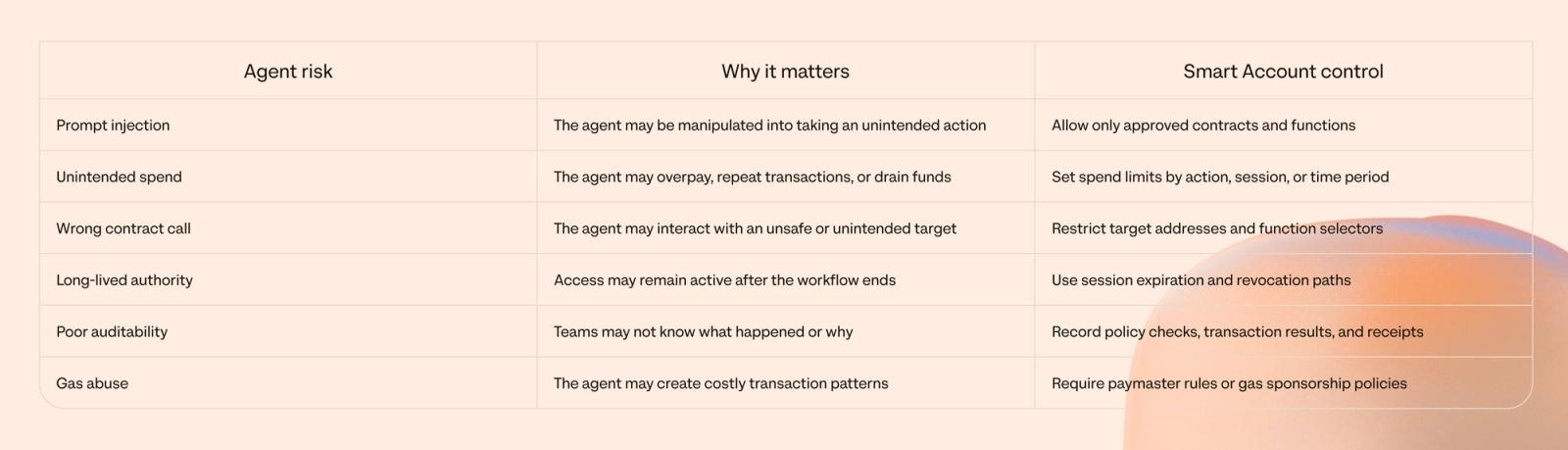
Raw signing authority gives the agent too much control and gives the builder too few safeguards. If the agent is manipulated through prompt injection, makes an incorrect decision, calls the wrong contract, or spends more than intended, the account layer may not provide meaningful protection.
The issue is not that agents should never act onchain. It is that agents should not need unlimited authority in order to be useful.
A safer model is to treat the agent as a delegated actor with limited permissions.
What Is a Session Key?
A session key is a temporary or limited-purpose signing key that can be assigned specific permissions.
Instead of giving an agent full wallet access, a session key can restrict the agent to a defined workflow. For example, a session key could allow an agent to:
- Interact only with a specific protocol
- Spend up to a fixed amount of USDC
- Operate only for the next three days
- Use only a specific paymaster
- Call only approved functions
- Revoke itself or be revoked by the account owner
Session keys are especially useful for agentic applications because they let agents act without becoming full account owners.
How Smart Accounts Make Onchain Agents Safer
Smart accounts give builders a control layer for autonomous execution.
Instead of trusting the agent with broad signing authority, teams can define permissions around the actual workflow. The smart account can then enforce those permissions before execution.
For onchain agents, smart accounts can support:
- Session keys for temporary or scoped access
- Spend limits to cap how much an agent can use
- Allowed targets to restrict which contracts or services the agent can call
- Policy logic to validate actions before execution
- Revocation paths to remove access when a workflow ends or risk changes
- Gas abstraction to sponsor or simplify transaction fees
- Receipts and logs to create a clearer record of agent activity
This creates a practical security model: trust the agent to make decisions within a defined scope, but rely on the account layer to enforce the boundaries.
A Safer Architecture for Onchain AI Agents
A production-ready onchain agent flow should separate intent, permissioning, execution, and verification.
1. Intent
The agent identifies the action it wants to take.
The intent might come from a user request, a scheduled workflow, a market condition, or an external service event.
Example: “Buy this dataset if the price is below 50 USDC.”
2. Permission Design
The application defines what the agent is allowed to do before it acts.
This may include approved contracts, function selectors, spending limits, time windows, gas rules, and revocation requirements.
Example: The agent can spend up to 50 USDC, call only the approved data marketplace contract, and act only within the next 24 hours.
3. Policy Check
Before execution, the requested action is checked against the account’s rules.
The system should ask:
- Is this contract allowed?
- Is this function allowed?
- Is the spend within limits?
- Is the session still valid?
- Does the request match the approved workflow?
- Is the correct paymaster or gas policy being used?
4. Execution
If the action passes policy, the smart account executes the transaction.
Gas can be paid by the user, sponsored by the application, or abstracted through a paymaster depending on the product experience.
5. Confirmation
The system confirms whether the action succeeded, failed, or requires follow-up.
The agent can then continue the workflow, notify the user, or stop based on the result.
6. Audit Trail
The action should be recorded so developers, users, or enterprise teams can understand what happened.
A useful audit trail should show:
- What action the agent requested
- Which policy allowed or rejected it
- What transaction was executed
- Whether the transaction succeeded
- What funds or permissions were used
This structure makes agentic workflows easier to reason about. The agent can still operate autonomously, but autonomy is bounded by account-level controls.
How ZeroDev Supports Scoped Agent Permissions
ZeroDev gives teams the smart account infrastructure needed to build agent workflows with scoped execution instead of raw key access.
With ZeroDev, developers can create smart accounts, issue session keys with specific permissions, sponsor or abstract gas through paymasters, and define policy logic around what an agent is allowed to do.
For example, an application could give an agent a session key that can:
- Call only approved contracts
- Spend only up to a defined limit
- Operate only during a fixed time window
- Use a required paymaster
- Be revoked when the workflow ends
That lets developers keep the user experience simple while moving enforcement into the account layer.
The agent can request an action. The smart account decides whether that action is valid.
ZeroDev helps teams abstract away key, gas, and execution complexity while preserving the control layer that autonomous workflows require.
Simple on the surface. Serious underneath.
Practical Checklist for Onchain Agent Builders
Before giving an agent onchain authority, teams should be able to answer these questions:
- What specific actions should this agent be allowed to take?
- Which contracts, services, or addresses can it interact with?
- Which functions can it call?
- How much can it spend per action, session, or time period?
- When does the permission start and expire?
- How can access be revoked?
- Who pays for gas?
- Does the workflow require a specific paymaster?
- What happens if the transaction fails?
- Where is the action logged?
- Can the workflow be audited after the fact?
- Is policy enforced outside the prompt?
If those answers are unclear, the agent likely has too much authority or too little infrastructure around it.
FAQ: Smart Accounts for Onchain AI Agents
Can an AI agent safely use a crypto wallet?
An AI agent should not use a wallet through unrestricted private-key access. A safer pattern is to use a smart account with scoped permissions, such as session keys, spend limits, approved contract targets, expiration times, revocation paths, and audit logs.
Why are private keys risky for autonomous agents?
A private key gives broad signing authority. If an agent is manipulated, misconfigured, or compromised, it may be able to move assets, call contracts, or spend funds beyond its intended role. Smart accounts reduce this risk by enforcing permissions before execution.
How do smart accounts help AI agents transact onchain?
Smart accounts let applications treat an agent as a delegated actor rather than a full wallet owner. The account can enforce what the agent is allowed to do, where it can transact, how much it can spend, and when its access ends.
What permissions should an onchain agent have?
An onchain agent should have the minimum authority required for its task. Typical permissions include allowed contract addresses, approved functions, spend limits, session expiration, gas policy, revocation rules, and logging requirements.
What is the difference between a session key and a private key?
A private key typically controls the full wallet. A session key is a limited-purpose key that can be constrained by permissions, time windows, spending limits, and allowed actions. For agents, session keys make automation possible without handing over full account control.
The Account Layer Is the Safety Layer
Onchain agents will unlock new product experiences, from autonomous payments to delegated workflows and real-time market participation. But they will only become useful at scale if teams can make them safe enough for real users and real businesses.
That requires a shift in how builders think about agent authority.
Do not give agents unlimited signing power. Give them scoped authority.
Define what they can do. Constrain where they can act. Cap what they can spend. Make revocation straightforward. Keep a record of what happened.
Smart accounts make that model possible.
Give agents the ability to act onchain, but keep control where it belongs: at the account layer.
Related articles

The EOA Transition: An In-Place Path to Native AA
ERC-4337 and Kernel proved that programmable accounts can work. The next step is native account abstraction that lets existing EOAs replace their root authorization without abandoning the address, assets, approvals, and history users already rely on.

Kernel v1–v4: What Production Kept and What It Left Behind
Across four versions, Kernel evolved from an EOA-shaped smart account into a modular foundation for replaceable validation, permissions, and EIP-7702. Its history reveals which account abstraction capabilities became durable products, and which still need better packaging.

ERC-4337 : Final, Not Finished
A builder’s retrospective on what ERC-4337 proved in production: less a path to mass smart-account migration, and more a shared rail for gas sponsorship, embedded onboarding, and programmable accounts.

Go from wallet friction to product velocity
If your team is blocked on account UX, gas, or chain complexity, ZeroDev gives you a practical place to start.