




Cross-Chain & Intents
Cross-Chain Funding: How to Design a Seamless Deposit-to-Action Flow
August 25, 2026

Cross-chain funding moves value from a user’s available source, such as a centralized exchange, fiat onramp, or another blockchain, into the account and asset state required to complete a product action.
Many cross-chain experiences begin too late. Teams optimize the transaction screen but leave users responsible for funding it. The user must choose a network, find a bridge, acquire the correct asset, transfer funds, source gas, and then return to the application.
This process exposes the infrastructure the product is meant to abstract. Users do not want a bridged balance for its own sake. They want enough usable value in the correct account to deposit, trade, stake, subscribe, or pay.
A better cross-chain funding design connects deposits, routing, account resolution, authorization, gas, execution, and recovery in one product flow. The outcome to optimize is not a confirmed bridge transfer. It is the time between receiving external funds and completing the user’s authorized product action.
Why Chain Abstraction Should Begin at the Deposit Screen
The funding screen is often the first place a product asks users to understand blockchain networks. It can quietly push several protocol-level decisions onto them:
- Which network should they withdraw from?
- Which version of a token should they send?
- Which address should receive the funds?
- How will the destination account pay for gas?
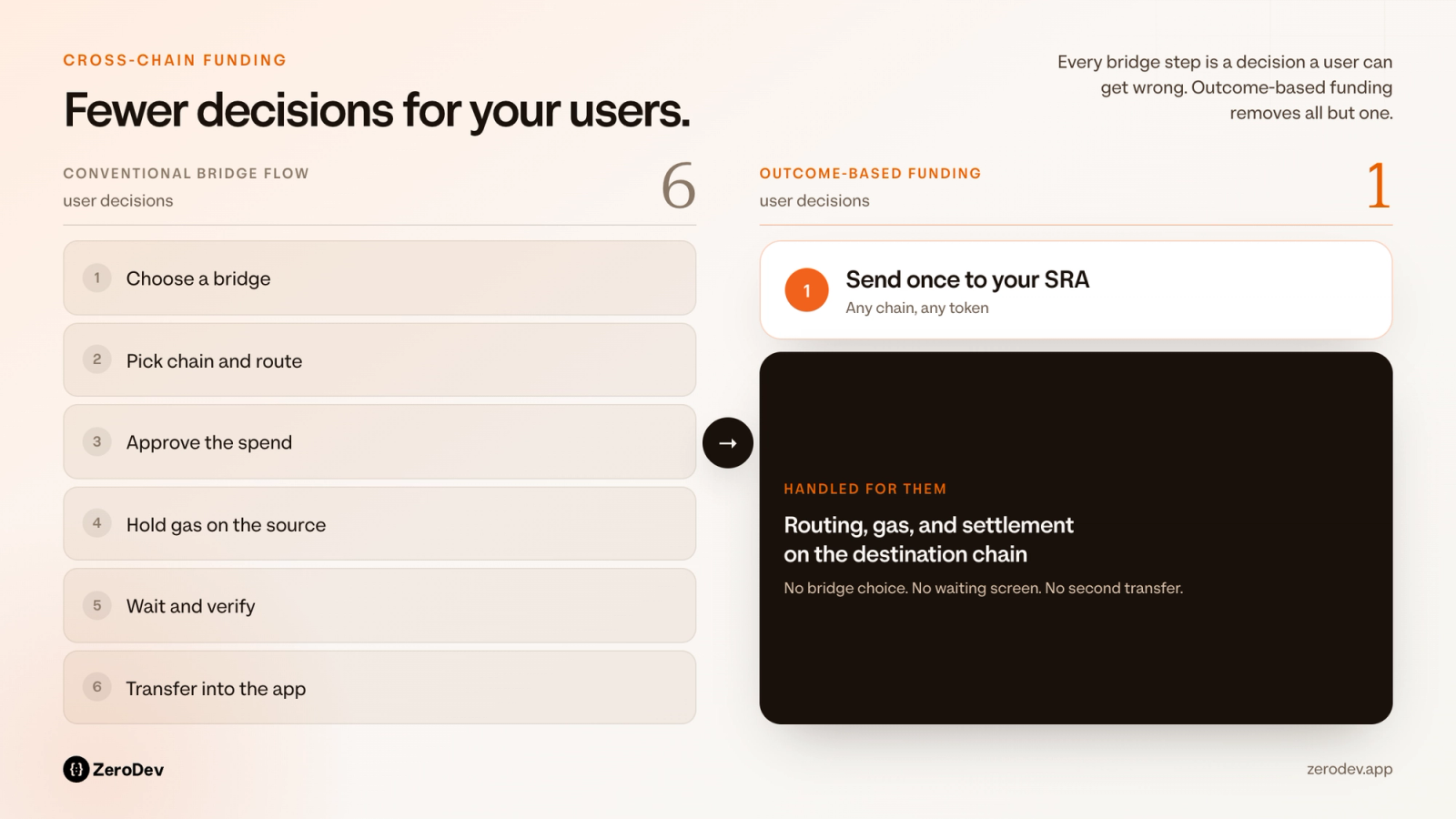
Every additional decision creates another potential failure point. A centralized exchange withdrawal could arrive on the wrong network. A fiat onramp might not support the chain on which the application operates. A user might receive stablecoins but have no native token for gas.
Even a technically successful transfer can leave the user with a balance that cannot fund the intended action.
When funding is treated only as infrastructure, the interface becomes a list of chains and assets. When it is treated as a product flow, the experience can begin with the desired outcome: fund this account so the user can complete this action.
ZeroDev Smart Routing Address provides an inbound layer for this model. It creates a destination-specific address that can receive configured funds from supported sources and trigger a defined intent on the destination chain. The destination becomes part of the funding design instead of another choice deferred to the user.
How to Map the Cross-Chain Deposit-to-Action Journey
Teams should model the complete funding journey as one state machine. Every stage needs a clear owner, user-facing status, timeout, and telemetry.
The useful sequence is not simply “deposit, then transact.” It includes seven connected stages.
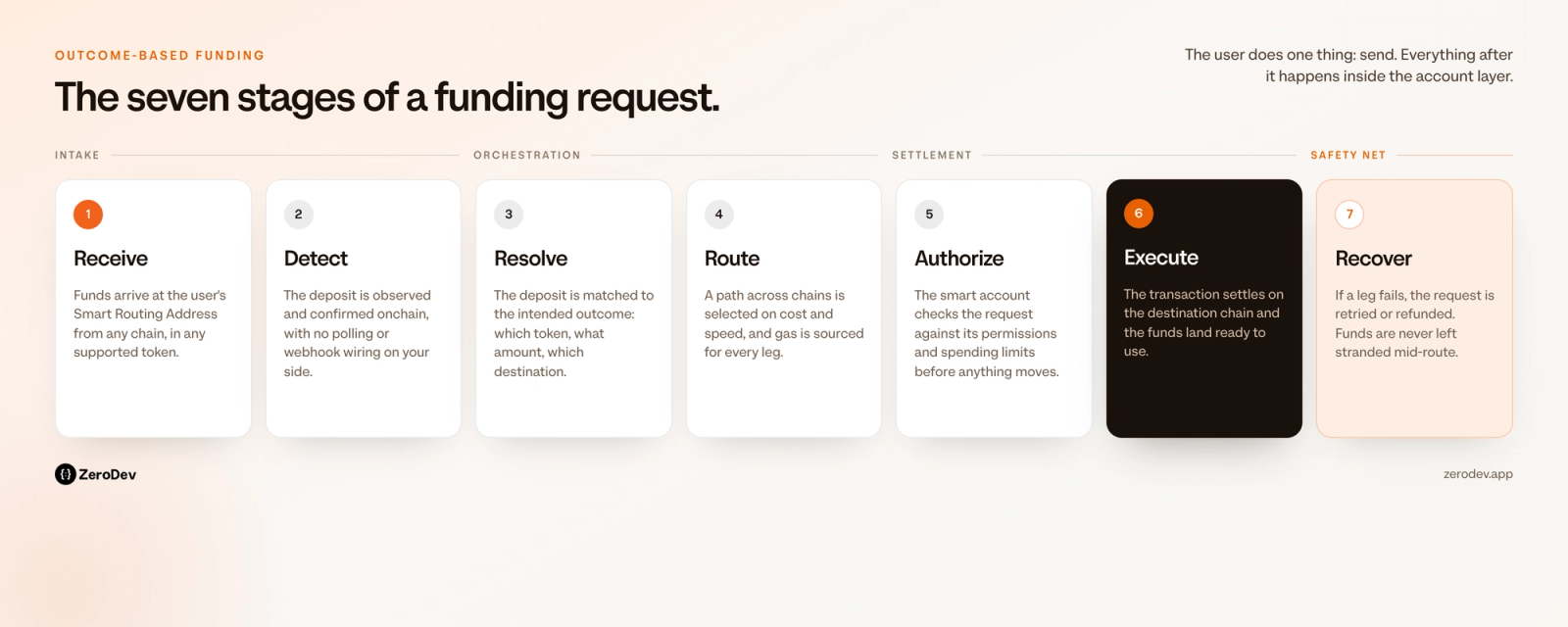
1. Receive the Deposit
Present an inbound address and clearly explain the supported funding conditions, including eligible source networks and assets.
2. Detect the Transfer
Observe the incoming transfer and identify its source chain, asset, and amount.
3. Resolve the Destination
Determine the destination chain, required output asset, recipient account, and intended product action.
4. Route the Value
Move or account for the funds according to the resolved route.
5. Authorize the Action
Confirm that the action is covered by explicit user consent and remains within the configured permission scope.
6. Execute the Transaction
Run the required call or atomic batch using the appropriate gas policy.
7. Recover When the Flow Cannot Complete
Return control to the designated recovery owner when the route or destination action fails.
This lifecycle also changes how teams divide responsibility. The funding interface, account layer, permissions system, execution service, and support tooling cannot each use unrelated statuses. They need shared identifiers and a common lifecycle capable of answering one question:
What can the user do with this deposit right now?
What Is a ZeroDev Smart Routing Address?
A ZeroDev Smart Routing Address is a destination-specific deposit address that accepts configured assets from supported source chains. Funding the address triggers a predefined cross-chain intent on the destination chain.
Funding often begins outside the application. Users may paste deposit addresses into exchange withdrawal forms, save them in address books, share them with treasury operators, or use them through onramps that cannot include application metadata.
A stable inbound address makes this external handoff more predictable. Users can send funds to one address under the configured source conditions, while the product defines the destination chain and action behind it. This is particularly useful when the funding source does not directly support the chain on which the application runs.
The key qualifier is configured. Products must clearly disclose which networks and assets the address supports. A persistent address should reduce repeated decisions without implying that every token on every chain will route automatically.
What a Cross-Chain Funding Screen Should Show
A cross-chain funding screen should tell users what they can send, what will happen, what the transaction is expected to cost, and how recovery works before they commit funds.
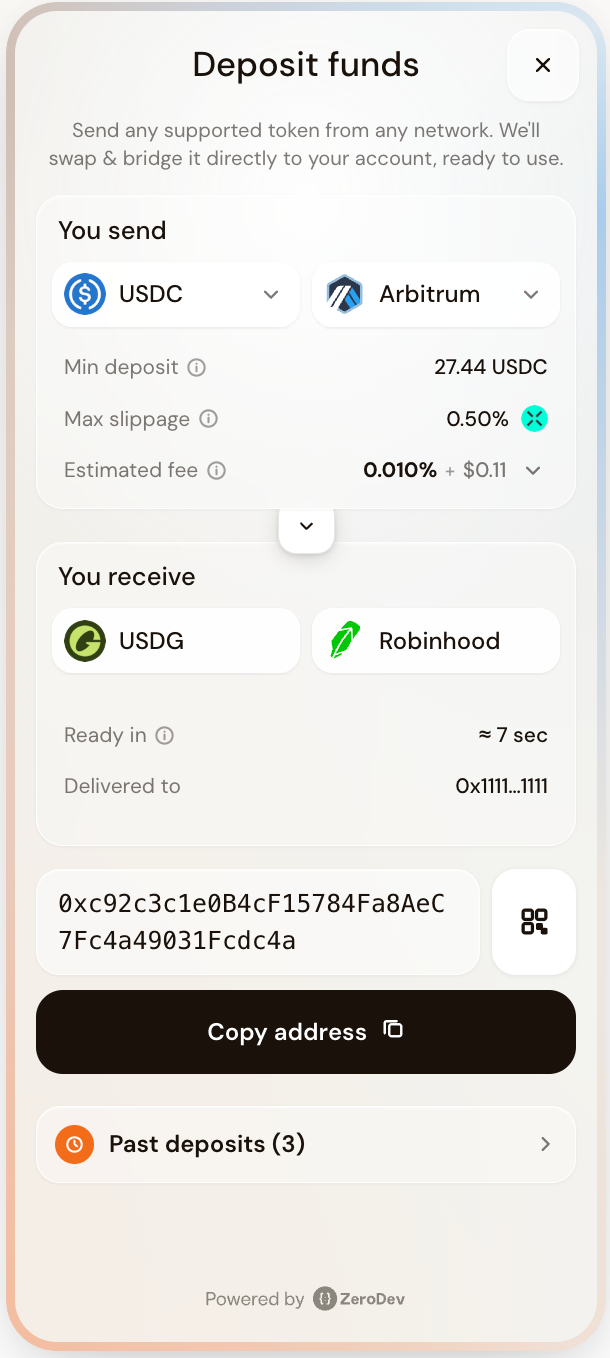
Supported Assets and Source Networks
List every asset and source network supported by the deposit address. Users need enough information to make a safe withdrawal without interpreting infrastructure configuration.
Destination Account and Product Outcome
Describe what the deposit will accomplish. Name the destination account and intended product outcome instead of showing only the destination chain.
For example, “Deposit USDC into your vault position on Base” is more useful than “Bridge USDC to Base.”
Estimated Fees and Output
Show expected fees, estimated output, and any quote or slippage sensitivity when that information is available.
Expected Timing
Provide a realistic time range or milestone-based status. Avoid relying on an indefinite spinner that gives users no indication of progress.
Failure and Recovery Options
Identify unsupported deposits and explain the recovery process before users transfer their funds.
The goal is confidence, not the removal of every technical detail. Display the network and asset information necessary for a safe withdrawal, but do not make infrastructure configuration the user’s primary task.
How to Resolve the Destination Chain, Asset, and Account
Once a deposit is detected, the routing system needs a deterministic destination model. Four fields should be resolved together:
- The chain on which the product action will run
- The asset required by that action
- The account that will own or use the funds
- The call representing the user’s intent
The destination should follow the product context. If a user is funding a vault on Base, the system should resolve the deposit toward the vault’s required asset and the user’s intended account on Base. It should not ask the user to choose from every technically possible route.
ZeroDev chain abstraction extends this model beyond a single routed deposit. A smart account can aggregate supported token balances across chains into a chain-abstracted balance. The account can then spend that balance on a destination chain without sending the user through a separate bridge interface.
Routing becomes an execution concern while the product presents the user with usable value.
Resolution still requires an explicit policy. Before proceeding, verify that:
- The source network and asset are supported.
- The output satisfies the intended action’s requirements.
- The recipient account is correct.
- The quote remains within the permitted tolerance.
- The selected gas policy is available.
If any check fails, move the flow into a defined recovery state instead of improvising an unsupported route.
How a Cross-Chain Deposit Can Trigger a Permitted Action
A deposit can fund a predefined action, but it should never be treated as unlimited consent to transact.
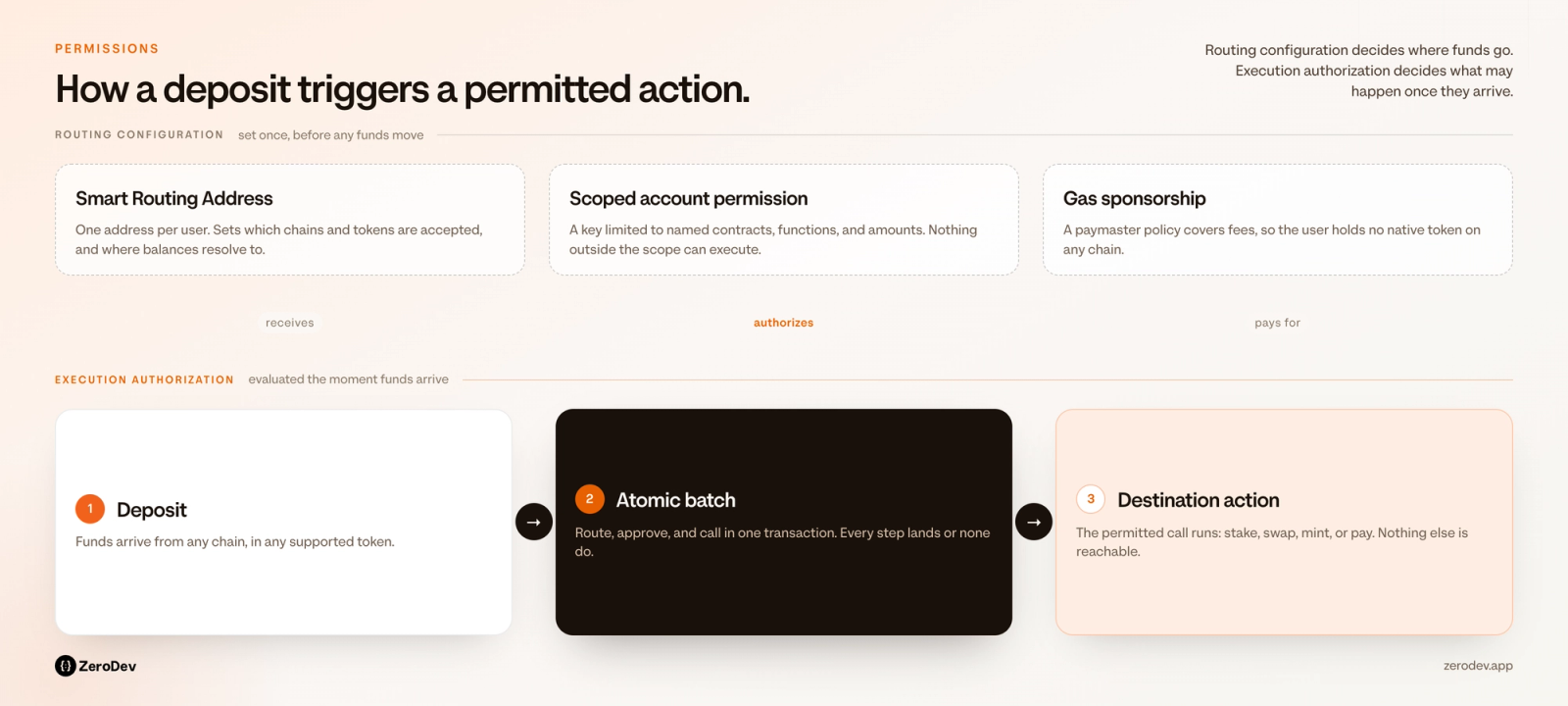
The strongest cross-chain funding experiences end with the outcome the user authorized, not merely with a “funds arrived” notification. When a Smart Routing Address is configured with destination actions, receiving a supported asset can trigger a defined call or sequence of calls.
If the product requires only asset delivery, route the funds to the intended recipient and present the next action separately.
Collect Consent Before the User Sends Funds
The funding screen should make the intended outcome visible and collect consent before funds are transferred.
Teams should distinguish between two separate concepts:
- The destination action configured for the routing address
- The smart account permission governing who may execute that action, under which policies, and through which execution function
ZeroDev permissions can restrict contracts, functions, parameters, gas usage, execution frequency, and time windows.
For a deposit-to-vault flow, the permission scope could be limited to:
- The specified vault contract
- The vault’s deposit function
- The funded asset
- The authorized deposit amount
The product should also define whether the permission is single-use, time-bounded, reusable, or revocable.
Use Batching and Gas Sponsorship to Simplify Execution
Smart accounts can make the authorized action feel like a single step. Batching can combine calls such as token approval and vault deposit into one atomic transaction. If one call reverts, the entire batch reverts instead of leaving the user halfway through the process.
A corresponding gas sponsorship policy can remove the requirement for users to hold native gas tokens, subject to the project’s configured limits.
The experience can remain simple without making authorization vague: one deposit funds one visible outcome under one bounded permission, with one result for the user to verify.
Cross-Chain Deposit States and Recovery Paths
A cross-chain deposit should be considered complete only when the intended product state exists and the user can verify it. Source-chain confirmation alone is not enough.
Because cross-chain flows contain several asynchronous steps, a single spinner hides important information and makes support more difficult. Use states that explain what happened, what the system is doing, and what the user can do next.
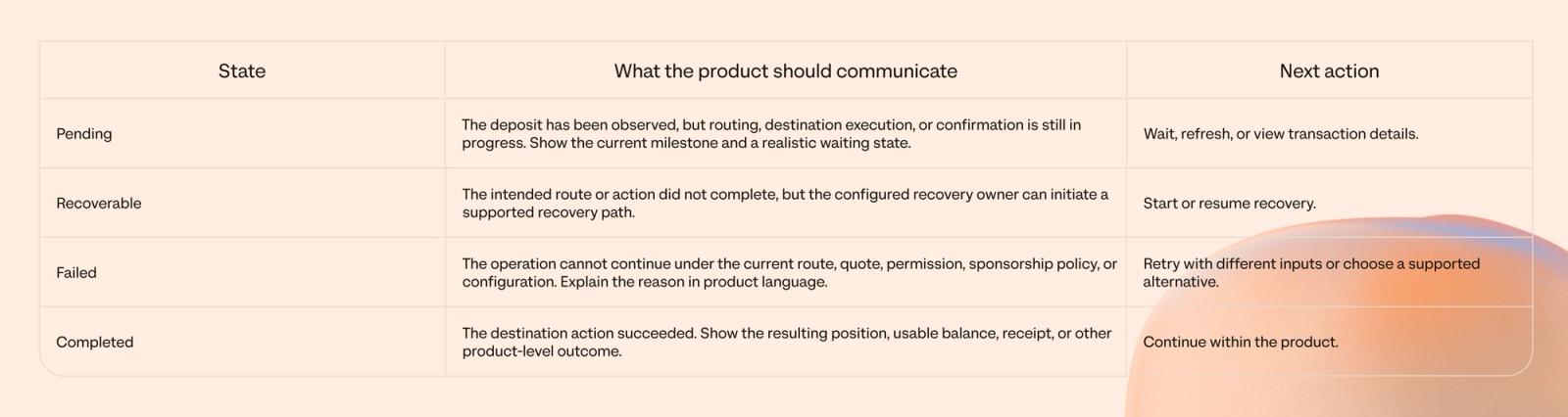
Design Recovery Alongside Routing
Recovery should be part of the original funding design, not a feature added after launch.
Smart Routing Address supports an owner address authorized to recover funds when the intended action cannot execute. The recovery owner may be the user’s address or a product-controlled address. This choice must be explicit because it changes the product’s operational and trust model.
Recovery should use the same lifecycle visible to the product and support teams. Do not mark a flow as completed merely because the input transaction was confirmed. Completion means the intended product state exists and the user can see it.
How to Measure Cross-Chain Funding Performance
The primary performance metrics should be time to usable balance and time to first successful product action.
These metrics describe user readiness rather than isolated infrastructure activity.
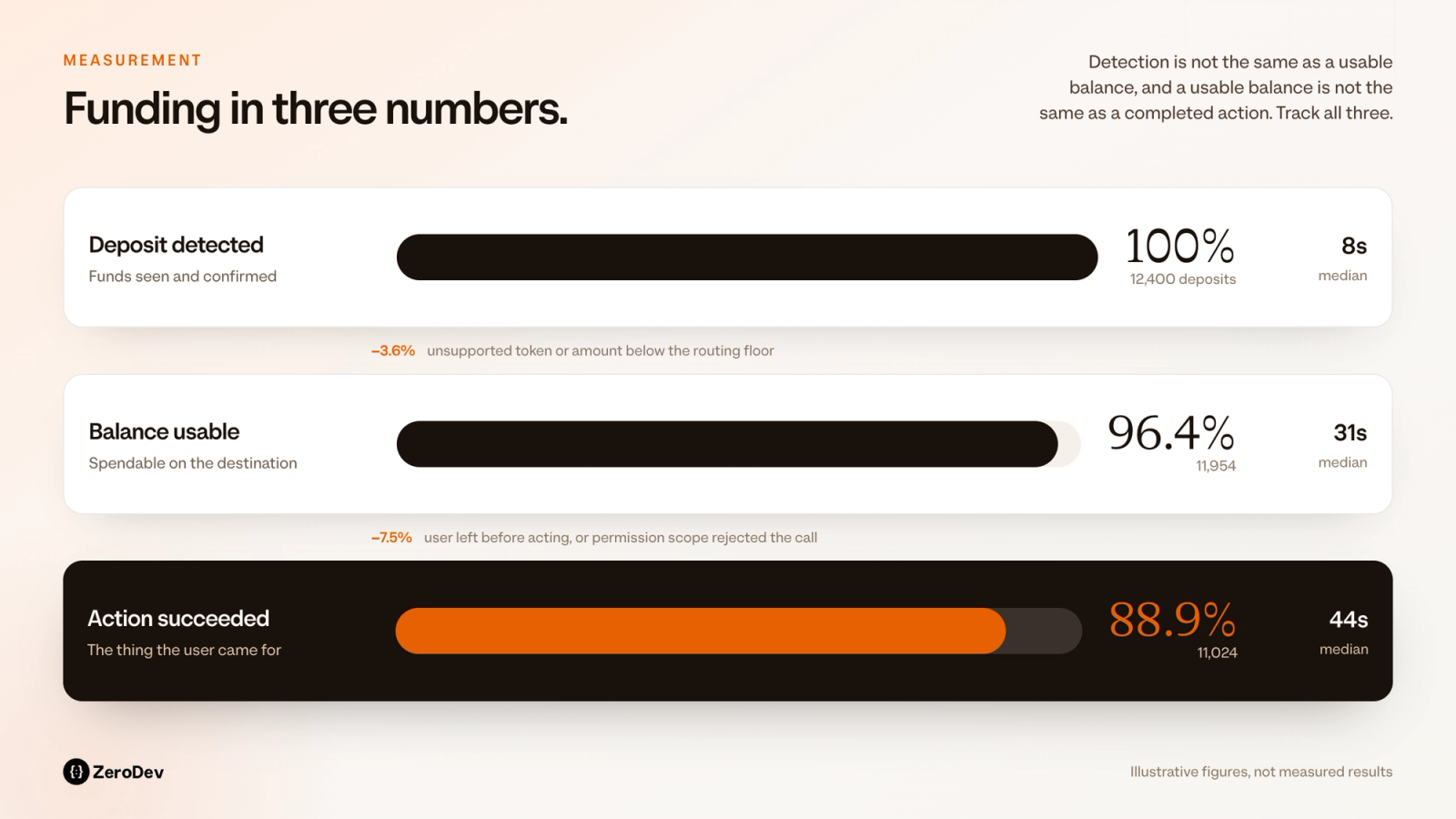
Time to Usable Balance
Measure the elapsed time from deposit detection until the funds can support their intended destination use. The result may be a destination-chain balance or a balance the smart account can spend through chain abstraction.
Time to First Successful Action
Measure the elapsed time from deposit detection until the first completed product action funded by that deposit.
For action-on-arrival flows, these two measurements may converge. For delivery-only funding, the gap between them reveals friction after the funds arrive. Possible causes include:
- Missing native gas tokens
- A separate token approval
- An unclear permission request
- A failed destination call
- Uncertainty about what to do next
Instrument Every Important Milestone
Track the events needed to explain where delays and failures occur:
- Routing address created
- Deposit detected
- Route opened
- Destination execution started
- Usable balance available
- Permission accepted
- Gas sponsorship approved or rejected
- Atomic batch submitted
- Product action completed
- Recovery initiated
- Recovery completed
Analyze performance by source network, asset, destination, route, account type, and product action. Report median performance and tail latency alongside state-integrity metrics such as:
- Stuck-deposit rate
- Action-revert rate
- Gas sponsorship rejection rate
- Wrong-asset rate
- Recovery rate
- Time to recovery
The goal is not to prove that routing is fast in isolation. It is to identify where funded users stop becoming active users.
Cross-Chain Funding Design Checklist
Before launching a deposit-to-action flow:
- Define the intended product outcome first.
- Publish supported source networks and assets.
- Explain expected fees and timing.
- Define the recovery owner and recovery experience.
- Collect scoped consent before funds are sent.
- Resolve the destination chain, asset, account, and action together.
- Use one shared lifecycle across product, infrastructure, and support tooling.
- Measure time to usable value and time to the first successful action.
- Treat the flow as complete only when users can verify the intended product state.
Design the Outcome, Then Abstract the Route
A deposit should not end with a bridge receipt. It should end with the user in the product state they intended to reach.
That requires one connected design surface spanning funding, account resolution, routing, permissions, gas, execution, and recovery. ZeroDev brings these layers together through Smart Routing Address, smart accounts, gas sponsorship, batching, composable permissions, and chain abstraction.
The implementation may cross contracts, networks, solvers, paymasters, and account plugins. The product experience should still read as one clear sentence:
Deposit here, and this permitted action happens.
Start building a deposit-to-action flow with the Smart Routing Address quickstart, and Permissions documentation. Want to see it in action? Check out our Smart Routing Address Demo here.

Go from wallet friction to product velocity
If your team is blocked on account UX, gas, or chain complexity, ZeroDev gives you a practical place to start.